Tuesday, 13 December 2011

Familes are not factories

I'm guest blogging at The F Word this December! This is the first post, published last week: http://www.thefword.org.uk/blog/2011/12/post_6
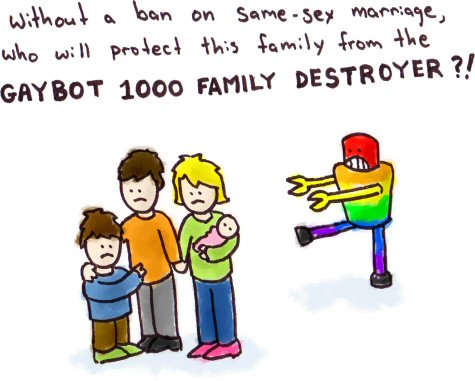

Good question. Tangentially relevant to this post.


My parents have been married for thirty years. I grew up in a semi-detached house in a suburb, one of three kids. The only surprise in the set-up is that we don’t have a picket fence. It was a Tory government’s wet dream of an upbringing. 
Somewhere along the line, though, something went wrong. The conveyer-belt churning out endless, identical replications of this ideal kinship model hit a snag, shuddered and stopped. It turned out one of the slightly-more-than-2.4 kids was queer and at least one of the others didn’t really give a damn about marriage. Our predicted stable, nuclear futures wobbled as reality, in all its glorious diversity, failed to conform to ideology.  
Thank god, then, for the government, who have announced the return, albeit in diluted form, of Thatcher’s Clause 28. Children in free schools or academies will in future be receiving heterosexist brainwashing instead of Sex and Relationships Education. Perhaps they can halt the cultural decline in straight people buying into holy matrimony by literally legislating for its ideological imposition? 
How obnoxiously weird that a practice designed to institutionalise the exchange of women-as-commodities should, in 2011, be being brought back as if it’s the only excellent kinship model. Over one third of marriages end in divorce, we know that only about 50% of people get married anyway - why do conservatives insist on touting the myth that marriage provides a stability that other forms of relationship don’t? Could they actually believe it, or is this a Dorries-esque way of grooming the next generation’s prejudices against the rights of those who threateningly queer the picture? 
Against all the evidence suggesting that other relationship models are also great, we are hugely invested in the ideal of marriage, in particular, in the importance of marriage to women. Popular, mildly-misogynist TV shows Don’t Tell the Bride and Four Weddings (both guilty pleasures, I admit) speak to this, camping up the ‘greatest-day-of-her-life’ aesthetic until it is too absurd to take seriously. Unless you’re Michael Gove, who presumably resolved to bring back Clause 28 during the Don’t Tell the Bride adverts. 
Given how much pro-marriage marketing we receive, perhaps it is not surprising that our common cultural conception is that it is vaguely ‘best for children’ if they grow up with married hetero-parents. The viciousness of anti-single-mother rhetoric, returning time again to narratives of blame and failure, only compounds this problem. The government spectacularly fails to consider the possible impact of such negative socialisation on children growing up in single-parent households. 
No matter. It is best for children to be brought up by married heterosexual couples , apparently, because two parents provide more stability than one. If an extra parent is so great, why wouldn’t it be better to have more than two? Why not four? Or ten? Why don’t we bring children up in communes, as envisaged by our feminist foremothers? 
I want to know why a marriage certificate makes a difference, if it is not just to get couples bogged down in financial commitments to each other so that they can’t separate. I’d like to know, moreover, how it could be better for children to grow up the company of two parents who would really rather have gone their separate ways, and why it is thought to be right that parents abnegate those - potentially eighteen - years of their lives ‘for the sake of the children’. I’d like to know why gender is presumed to make a difference to that equation, why God is genuinely believed to have given a shit about anybody’s chromosomes. 
Clause 28 is a case of cart-before-horse. There is nothing inherently better about nuclear families except the belief that they are better (coupled with tax breaks). If the children of hetero-marriages turn out to be better adjusted, whatever the hell that means, than those from other families, we need to look at the ways in which the former set of children are systematically culturally privileged and change the system accordingly. To conclude that therefore marriage is best and should be preached to kids is question-beggingly circular. It perpetuates the cycle, excluding those who can’t or won’t fit. 
I have seen at first hand that a heterosexual marriage can provide a stable upbringing in which children can grow. But I would contend that if there is anything about my orientation which would prevent me from bringing up kids in just as good a manner, it is the attitude of Gove and co, who, through Clause 28, will attempt to make sure that the society my children will grow up in will be even more full of hate than the society we have now. Thanks Gove, you utter wanker. 

Friday, 2 December 2011

Thursday, 3 November 2011

Here is my opinion, deal with it: on real life silencing and internet abuse


Edited version of this post published at Liberal Conspiracy: http://liberalconspiracy.org/2011/11/04/how-womens-voices-are-silenced-online-through-trolling/


It's funny because it's, like, true


It's difficult for women to speak in public, particularly political women. Today Helen Hasteley-Lewis blogged at the New Statesman about the torrential online abuse feminist writers get. This follows Cath Elliott's blog earlier this year on the shocking invective she personally regularly receives. At the moment, the internet is a society where being (perceived as) female and writing about feminism invariably leads to responses on the theme of: 'shut up or I will rape you/you're ugly and deserve to be raped/you're too ugly to be raped'. 

This is a form of silencing, an internalised gendered behavior which acts reflexively to suppress challenging opinions - particularly those vocalised by women. Abuse is more explicitly misogynist online, where trolls can hide behind anonymised usernames, but it isn't a phenomenon isolated to the internet. The watered-down version plays out offline all the time.

Show me a mixed gender group of any sort and I will show you a group where men speak more than women, where women are regularly interrupted, where something ignored when said by a woman will be praised when said by a man.* Debates about the merits of women-only spaces sometimes ignore the value, for women, of being in a group where they are not constantly struggling to be heard.

This is not to say that there aren't loud, opinionated, dominating women, or shy, retiring men, or that people biologically conform to a gender binary. It not to say that ALL WOMEN are one way and ALL MEN are another way. It's not to say that silencing doesn't happen along other axes of oppression, race and class being two of the rather pertinent ones. It is, however, to say that a meaningful gender analysis can be enacted on the ways that women's voices are publicly stifled. It is to say that the loud, opinionated, dominating women who want to write have to get past discriminations that loud, opinionated, dominating men don't. Online abuse is just the most blatant example of this.


How does silencing work? Partially, it works by ad feminam response. Suppose that Fictional-but-also-factual-John and I are having a discussion. I say that I think silencing is something that is usually directed against women by men in order to shut them up. John replies with, 'okay, but you don't have to be so angry about it all the time/you're cute when you're political!/did someone get out of bed on the wrong side this morning?/you don't have to make it about gender all the time/you're just saying that because you're a woman/ok...come here and kiss me/yeah but you're fat and ugly and therefore irrelevant', and so on. My opinion is sidestepped; irony abounds. Next time, it is harder to speak.


Silencing works by trivialisation of what women say, through mockery of what women say, through reducing-women-to-sexual-appearance. Subconsciously, we have internalised the idea that whatever it is, it is better if it comes from the mouth of a man than from a woman. It happens all the time. Ever seen a group of men sitting around making jokes as their female friends laugh appreciatively? I have, and I've also seen what often (but not always) happens when women try to join in. Anecdotal it may be, but at some point collections of women's experiences become overwhelming evidence. Women are being told online that they're sexually unattractive femi-nazis who deserve to be attacked, and being ignored/mocked/trivialised offline. After being silenced once, twice, a thousand times, I find it surprising that anybody has the labia to say anything at all. 

If you, of any gender, find yourself instinctively disregarding what a woman is saying, if you find yourself not listening, or wanting to interrupt, or looking at the clock, you are enacting a form of silencing. If find yourself thinking, 'what a cow/bitch/hag' when a woman is saying something in an outspoken fashion, you are taking part in the mentality of silencing. Take a step back, have a look at your own privilege, and then, please, stop doing it.


*For more on this, see Cordelia Fine's Delusions of Gender. 

Wednesday, 19 October 2011

The problem with sexy children


This look: correct in women, totally perverse in children


Sexualisation: a buzzword for feminists, Christians and conservative party leaders. Most people agree it's a Bad Thing, particularly when it happens to our delicate little children, who must be protected. If sexualisation is impacting upon children, says everybody, then, and only then, must we take rigorous measures to oppose it. In particular, we must complain about Rihanna dancing on X-Factor in her too-risque undies, and make sure that schoolgirls wear trousers so that they don't invite sexual assault. In case you were face-palming there, let's just say that the latter policy clearly springs from the same mind that wrote the hilarious joke: 'what's the leading cause of peodophilia?'... 'sexy children'.

A desultory review of the internet literature on sexualisation reveals that it's affecting children everywhere. It pervades our culture through magazines, 'pornstar' slogans on children's clothing, under-wired bras for little girls, music videos (though the fixation is on female pop stars, not the male hip hop artists who use naked-gyrating-women as legal tender), television generally, and so on. These impressionable young minds see it, take it in, and start acting like sexy adults far too young. The solution, therefore, apparently, is to stop our children seeing sex-related things. 


Of course it would be totally fine if she was a bit older..
The most recent governmentally commissioned research on this, the Bailey Review of the Commercialisation and Sexualisation of Childhood, deliberately fails to define sexualisation. That's because it was written by a man whose agenda is not anti-sexualisation, but anti-sex. For Bailey, 'sexualisation' is just convenient modern jargon to slip a right-wing agenda under the policy radar.

Let's stop pretending that children and young adolescents don't have sexualities. Don't you remember your furtive childhood wanks? It's simply ridiculous to believe that sexuality rightfully gets switched on when we reach the age of consent, as if the benchmark 'sixteen' represents anything other than an arbitrary regulatory decision of the state.

The problem is not sex but its cultural implementation, and an aspect of that is the difference between sex and sexualisation. Part of me doesn't want my figurative children to find out just how limiting, sexist, racist, homophobic, etc, adult women's cultural sexual representation is, but I'm not going to sit around acting as if stopping them from seeing the images does anything to stop the images-as-messages from being there.

Girls are not sexualised because they develop and experience their own sexualities, nor are children-who-must-be-protected generally sexualised because they have sex. Girls are sexualised, rather, because women's and girl's sexualities are still culturally defined in a way that detaches genuine sexual pleasure from the body, replacing it with a narrow, limiting appearance of (submissive) arousal. Ariel Levy was saying something similar to this six years ago, by the way. Why is it considered sexy for women but not men to wear make-up, heels and lingerie? (I personally think men in make-up, heels and lingerie are incredibly sexy, but I seem to be the perverse minority)

The Bailey Review correctly identifies sexualised products, but doesn't really pick up on the other problems that comprise sexualisation: the normalisation of a particular kind of sexy-woman standard that all women are held up as wanting against. Sexualisation is a horrifically gendered thing whereby men sexually consume agency devoid women-commodities. The extensive possibilities for and variations in peoples' sexualities are denied except where they match the man-fucks-sexy-woman standard. I recognise that some women get off perfectly well under the popular narrative, which is great for them, but even as much as sexuality reflects society, many still cannot fit the box.

There is a fundamental problem with the idea that sexualisation is terrible up until the age of sixteen, at which point it's all fine and normal (The Bailey Review uses the term 'premature sexualisation'!) It's sad that girls will have to resist everything the sexualised society tells them about themselves, their desires and their bodies, in order to have fulfilling sex lives. Yet I would almost prefer that they learn about it early so that they can start developing the critical tools to call it out for what it is - a fabricated belief system of the misogynist imagination. Perhaps children should know their enemy. 
Related Posts Plugin for WordPress, Blogger...