Showing posts with label education. Show all posts

Tuesday, 23 October 2012

"Intersectionality", let me Google that for you

So great? 

It's all kicked off on twitter over the last two days since The V Spot's problematic blog "In defence of Caitlin Moran and populist feminism".

In response, I've written a piece over at New Statesman.

It's called "'Intersectionality', let me Google that for you." It's on the issue of who feminism is for: http://www.newstatesman.com/lifestyle/2012/10/intersectionality-let-me-google-you


Here are some great pieces by others on the same debate:

Dear Vagenda editors: http://blackfeminists.org/2012/10/23/dear-vagenda-editors/

You don't need an MA in Gender Studies to know that race matters to feminism: http://www.guardian.co.uk/commentisfree/2012/oct/23/race-matters-to-feminism

How to be better: on intersectionality, privilege and silencing: http://stavvers.wordpress.com/2012/10/22/how-to-be-better-on-intersectionality-privilege-and-silencing/


Tuesday, 2 October 2012

Five top tips for getting a job


You've finally graduated, with a good combined degree in Humanities and Other Useless Studies. You spent your university years relatively well. You played sport for a team, you joined an orchestra. You had a social life. You're reasonably well rounded, and entirely sure that you can a: answer the telephone, b: send an "email" and c: talk to people without accidentally saying "cunt". Ready to take on the adult world of employment.

But the glorious, hopeful summer has now turned to October, and you're sitting in your parents' kitchen in yesterday's pants with a mysterious crust on your face (this bears no relation to my own life, I'm totally fine. Having a great time, actually). You're on your fifth cup of instant coffee and its only ten in the morning. You're flicking through the same unpromising job ads that you've seen every day this week. Most of them tell you neither what the job is nor who it would be for, but they do use plenty of fun, meaningless phrases like "self starter".

The fortnightly trips to the job centre take on a nightmarish air. The night before sign-on day you wake up in your sleep, soaked in sweat. Will you be able to convince the sceptical woman behind the desk that you are worthy of this week's £56.25? Difficult to say, when passing the test to keep your benefits depends on you accepting individual blame for the failings of the political system.

Of course, there's always an opening in recruitment consulting, bribing other people into becoming recruitment consultants. If you don't think about it hard enough, maybe you won't notice that its an empty, self-perpetuating job cycle created to give desperate graduates something to do. Sometimes these consultants even call you up, deliberately ignoring whatever sector it is you marked as desirable on your CV:

Consultant: "Would you like a mind-numbingly boring job that you have absolutely no interest in?"

You: "No, thank you kindly"

Consultant: "You are clearly a benefits scrounging loser. I read about your kind in the Telegraph."


I've never had a conversation like that, but it's only a matter of time.


In any case, from one work-shy feckless job-seeker to another, here are my five top tips for getting a job. They have served me admirably well in the past:


1. Start your cover letter thus:

"Dear Company,

I have no idea who you are or what you do, but frankly the position advertised is an insult to someone of my abilities. Obviously I am capable of filing, answering the telephone, and making tea. During my degree I had to write essays about dialectical materialism, for fuck's sake. Please, please, please give me this job, I really need the money."


2. Apply for unpaid internships. When they offer them to you ask if they'll pay you. If not, turn them down in an outraged email railing against slave labour, linking them to the wikipedia page for the principle of "a fair day's wage for a fair day's work". Repeat.


3. Turn down any job offers you receive. If they're offering you a job, it can't be that great a job. What's wrong with them? (See: Groucho Marx)


4. Write intimidating speculative applications to companies who don't have job openings. Threaten to leave the country if they don't create a job for you. Why should multi-billion pound businesses receive favorable treatment?


5. Whenever friends, parents, partners or bloggers try to give you well-meant job advice, laugh long and loudly. You have no need of their advice! Have you not sent five thousand applications this very week! Do you not have as much chance as anyone else of landing the BBC Director-General job (as and when George Entwistle vacates it)? Shout all these things aggressively, then cry and run out of the room.


Good luck! You'll need it! 

Thursday, 23 February 2012

"Justice" for Dominique Strauss-Kahn? Don't make me laugh.


Oh hey! Do you like knowing you're right? Me too! What about justice? Hooray for justice! How about demonstrations of blindingly ignorant privilege coated in the faux-language of 'objectivity' or 'reason'? Wait, what..?

Privilege Denying Dude: he's always right


I didn't study gender at school. My school syllabus was based on the theories white English guys made up about the world for the past thousand years. At school, some things were up for nuanced interpretation, like English literature (a girls' subject). Sometimes, at most, we were asked to consider 'the role of women in...' But hard, manly subjects like science and maths, defined as fact, could not be disputed.

Apparently there's a major branch of theoretical thought called 'feminist epistemology', or something. Most people don't know about it, because we only learn white-guy-theories at school. One of the great things it does is to challenge the idea that what a culture thinks of as "knowledge" is objective, or neutral. Here's a quote that summarises the central point nicely:


"One cannot survey the human race from a great and learned distance, proclaiming loudly that one has found the truth for the good of all the nameless faceless abstractions that one has never bothered to take seriously." (Elshtain, 1981)


And here's another:


"Reflection on how social phenomena get defined as problems in need of explanation in the first place quickly reveals that there is no such thing as a problem without a person (or groups of them) who have this problem: a problem is always a problem for someone or other." (Harding, 1987)


In other words, feminist epistemology focuses on the roles of real people in abstract theorizing. When we're talking about knowledge, it matters who is doing the knowledge acquisition, and who the knowledge is being acquired about. The people involved - their positions as members of oppressed or privileged groups - affect what facts get churned out, and who gets to decide what counts as fact.

What falls out of feminist epistemology is the extent to which "knowledge" generally reflects the perspectives, not to mention the will to power, of the people in charge. How do societies come to believe that we are most threatened by those who are worst off: the Jews, the immigrants, the blacks, the gays, the benefits scroungers? As a direct result of the taken-for-granted "knowledges" made up by those with more power, that's how. And we believe it. We read the newspapers, we absorb the prejudices handed to us.

Dominique Strauss-Kahn, despite facing (or rather, evading) repeated allegations of rape and sexual assault, gets to speak at the Cambridge Union debating society because of these power imbalances in the process of knowing. Facts about "the law", "justice", "innocent until proven guilty" are taught to us year in and year out. These are the representative tenets of our great liberal democratic society. They are the mighty principles of the fair society, we must uphold them, free of nuance, free of interpretation, lest we become a Stalinist Soviet Union! Innocent until proven guilty! That's an objective fact! You don't get to decide the law, the law does, and the law is defined as not-wrong!

But there are other facts here that don't get heard, or taught, or learned. These are the facts about the crimes of those with more power against those with less power, and the proportion of the time that the law fails to uphold justice when the victim is a woman, or a person of colour, or someone defined as 'vulnerable'. Could a black chamber maid ever prove a rape case against the white male leader of a political body? I doubt it, whatever the evidence was.

Do I need to quote, again, the attrition rate for rape cases in the UK? It's less than 6% Do I need to mention that 1 in 7 women experience sexual or physical violence whilst students, that about 1 in 4 women are sexually assaulted as adults? Is it worth pointing out, again, how many cases there are, how few of them reach the police? What about the figure for the number of cases reported that are simply dropped due to what dominant knowledges say about false allegations?

I'm so bored of talking about these facts, but no one from the "innocent until proven guilty" camp considers this to be valid knowledge, worth using to interrogate Dominique Strauss-Kahn's free pass to propound his views. Instead, we hear "innocent until proven guilty" repeated over, and over, and over, like a cult mantra. That's the only knowledge that counts, the justice that protects the rights of the guys in charge.

What about the "innocent until proven guilty" that should have been upheld for Nafissatou Diallo and Tristane Banon? Instead we had the "guilty, just guilty" treatment meted out to Diallo, and the "you have a case, but the law is designed to stop us from pursuing it" reaction to Banon. Given that the law did nothing for them, I reckon Cambridge should give them the benefit of the doubt. I'd suggest that we should believe that they aren't just vindictive, pathological liars - but of course that's not the kind of justice that we're used to.


For what it's worth, I agree with "innocent until proven guilty". It just doesn't apply here. We don't have a fair process for finding people guilty. Dominique Strauss-Kahn isn't going to court on these charges - he got let off. 


The case against Dominique Strauss-Kahn is damning: Diallo and Banon are just the women who have come forward. Their heinous treatment at the hands of the law, in the name of "justice", suggests to me that Dominique Strauss-Kahn will go on to rape and to assault with impunity. And all the while student debating societies will invite him to chat about economics. After all, it's a much more important subject, rooted in facts and objectivity. That's the stuff that really counts.


To sign the Disinvite Dominique Strauss-Kahn petition, click here: http://www.womens.cusu.cam.ac.uk/campaigns/strausskahn/

Tuesday, 13 December 2011

Familes are not factories

I'm guest blogging at The F Word this December! This is the first post, published last week: http://www.thefword.org.uk/blog/2011/12/post_6


Good question. Tangentially relevant to this post.


My parents have been married for thirty years. I grew up in a semi-detached house in a suburb, one of three kids. The only surprise in the set-up is that we don’t have a picket fence. It was a Tory government’s wet dream of an upbringing. 
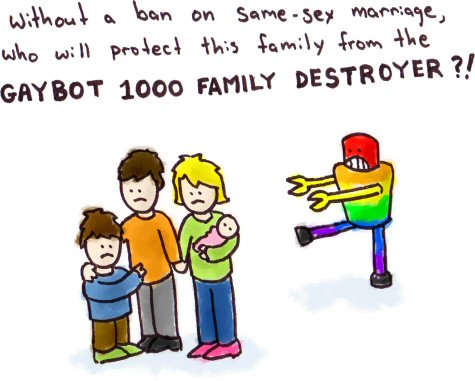
Somewhere along the line, though, something went wrong. The conveyer-belt churning out endless, identical replications of this ideal kinship model hit a snag, shuddered and stopped. It turned out one of the slightly-more-than-2.4 kids was queer and at least one of the others didn’t really give a damn about marriage. Our predicted stable, nuclear futures wobbled as reality, in all its glorious diversity, failed to conform to ideology.  
Thank god, then, for the government, who have announced the return, albeit in diluted form, of Thatcher’s Clause 28. Children in free schools or academies will in future be receiving heterosexist brainwashing instead of Sex and Relationships Education. Perhaps they can halt the cultural decline in straight people buying into holy matrimony by literally legislating for its ideological imposition? 
How obnoxiously weird that a practice designed to institutionalise the exchange of women-as-commodities should, in 2011, be being brought back as if it’s the only excellent kinship model. Over one third of marriages end in divorce, we know that only about 50% of people get married anyway - why do conservatives insist on touting the myth that marriage provides a stability that other forms of relationship don’t? Could they actually believe it, or is this a Dorries-esque way of grooming the next generation’s prejudices against the rights of those who threateningly queer the picture? 
Against all the evidence suggesting that other relationship models are also great, we are hugely invested in the ideal of marriage, in particular, in the importance of marriage to women. Popular, mildly-misogynist TV shows Don’t Tell the Bride and Four Weddings (both guilty pleasures, I admit) speak to this, camping up the ‘greatest-day-of-her-life’ aesthetic until it is too absurd to take seriously. Unless you’re Michael Gove, who presumably resolved to bring back Clause 28 during the Don’t Tell the Bride adverts. 
Given how much pro-marriage marketing we receive, perhaps it is not surprising that our common cultural conception is that it is vaguely ‘best for children’ if they grow up with married hetero-parents. The viciousness of anti-single-mother rhetoric, returning time again to narratives of blame and failure, only compounds this problem. The government spectacularly fails to consider the possible impact of such negative socialisation on children growing up in single-parent households. 
No matter. It is best for children to be brought up by married heterosexual couples , apparently, because two parents provide more stability than one. If an extra parent is so great, why wouldn’t it be better to have more than two? Why not four? Or ten? Why don’t we bring children up in communes, as envisaged by our feminist foremothers? 
I want to know why a marriage certificate makes a difference, if it is not just to get couples bogged down in financial commitments to each other so that they can’t separate. I’d like to know, moreover, how it could be better for children to grow up the company of two parents who would really rather have gone their separate ways, and why it is thought to be right that parents abnegate those - potentially eighteen - years of their lives ‘for the sake of the children’. I’d like to know why gender is presumed to make a difference to that equation, why God is genuinely believed to have given a shit about anybody’s chromosomes. 
Clause 28 is a case of cart-before-horse. There is nothing inherently better about nuclear families except the belief that they are better (coupled with tax breaks). If the children of hetero-marriages turn out to be better adjusted, whatever the hell that means, than those from other families, we need to look at the ways in which the former set of children are systematically culturally privileged and change the system accordingly. To conclude that therefore marriage is best and should be preached to kids is question-beggingly circular. It perpetuates the cycle, excluding those who can’t or won’t fit. 
I have seen at first hand that a heterosexual marriage can provide a stable upbringing in which children can grow. But I would contend that if there is anything about my orientation which would prevent me from bringing up kids in just as good a manner, it is the attitude of Gove and co, who, through Clause 28, will attempt to make sure that the society my children will grow up in will be even more full of hate than the society we have now. Thanks Gove, you utter wanker. 

Wednesday, 19 October 2011

The problem with sexy children


This look: correct in women, totally perverse in children


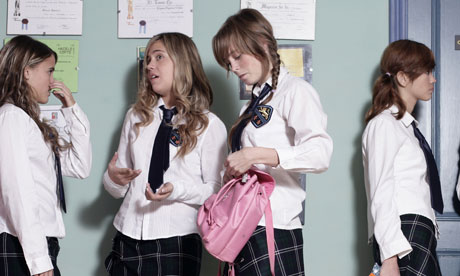
Sexualisation: a buzzword for feminists, Christians and conservative party leaders. Most people agree it's a Bad Thing, particularly when it happens to our delicate little children, who must be protected. If sexualisation is impacting upon children, says everybody, then, and only then, must we take rigorous measures to oppose it. In particular, we must complain about Rihanna dancing on X-Factor in her too-risque undies, and make sure that schoolgirls wear trousers so that they don't invite sexual assault. In case you were face-palming there, let's just say that the latter policy clearly springs from the same mind that wrote the hilarious joke: 'what's the leading cause of peodophilia?'... 'sexy children'.

A desultory review of the internet literature on sexualisation reveals that it's affecting children everywhere. It pervades our culture through magazines, 'pornstar' slogans on children's clothing, under-wired bras for little girls, music videos (though the fixation is on female pop stars, not the male hip hop artists who use naked-gyrating-women as legal tender), television generally, and so on. These impressionable young minds see it, take it in, and start acting like sexy adults far too young. The solution, therefore, apparently, is to stop our children seeing sex-related things. 


Of course it would be totally fine if she was a bit older..
The most recent governmentally commissioned research on this, the Bailey Review of the Commercialisation and Sexualisation of Childhood, deliberately fails to define sexualisation. That's because it was written by a man whose agenda is not anti-sexualisation, but anti-sex. For Bailey, 'sexualisation' is just convenient modern jargon to slip a right-wing agenda under the policy radar.

Let's stop pretending that children and young adolescents don't have sexualities. Don't you remember your furtive childhood wanks? It's simply ridiculous to believe that sexuality rightfully gets switched on when we reach the age of consent, as if the benchmark 'sixteen' represents anything other than an arbitrary regulatory decision of the state.

The problem is not sex but its cultural implementation, and an aspect of that is the difference between sex and sexualisation. Part of me doesn't want my figurative children to find out just how limiting, sexist, racist, homophobic, etc, adult women's cultural sexual representation is, but I'm not going to sit around acting as if stopping them from seeing the images does anything to stop the images-as-messages from being there.

Girls are not sexualised because they develop and experience their own sexualities, nor are children-who-must-be-protected generally sexualised because they have sex. Girls are sexualised, rather, because women's and girl's sexualities are still culturally defined in a way that detaches genuine sexual pleasure from the body, replacing it with a narrow, limiting appearance of (submissive) arousal. Ariel Levy was saying something similar to this six years ago, by the way. Why is it considered sexy for women but not men to wear make-up, heels and lingerie? (I personally think men in make-up, heels and lingerie are incredibly sexy, but I seem to be the perverse minority)

The Bailey Review correctly identifies sexualised products, but doesn't really pick up on the other problems that comprise sexualisation: the normalisation of a particular kind of sexy-woman standard that all women are held up as wanting against. Sexualisation is a horrifically gendered thing whereby men sexually consume agency devoid women-commodities. The extensive possibilities for and variations in peoples' sexualities are denied except where they match the man-fucks-sexy-woman standard. I recognise that some women get off perfectly well under the popular narrative, which is great for them, but even as much as sexuality reflects society, many still cannot fit the box.

There is a fundamental problem with the idea that sexualisation is terrible up until the age of sixteen, at which point it's all fine and normal (The Bailey Review uses the term 'premature sexualisation'!) It's sad that girls will have to resist everything the sexualised society tells them about themselves, their desires and their bodies, in order to have fulfilling sex lives. Yet I would almost prefer that they learn about it early so that they can start developing the critical tools to call it out for what it is - a fabricated belief system of the misogynist imagination. Perhaps children should know their enemy. 

Sunday, 4 September 2011

You can't smash patriarchy with transphobia


You should totally check out Bornstein's book Gender Outlaw. It's awesome. 

I spent a lot of time thinking about radical feminist transphobia whilst writing my undergrad dissertation (on whether trans theoretical and radical feminist ideologies are fundamentally at odds). When writing it, I treated the conflict as feminist history that had really been put to bed by writers like Sandy Stone, Patrick Califia and Kate Bornstein (above). It's strange and upsetting, but then perhaps not so surprising, to see that feminist transphobia is alive and well outside of the ivory tower.


You will be pleased to find that this article is marginally less wanky than my dissertation: http://www.thefword.org.uk/features/2011/09/radical_feminism_transphobia

Thursday, 1 September 2011

Speaking out about abortion: four women share their stories.


I go to sleep fantasizing about shouting this at Nadine Dorries

So Downing Street looks set to advise MPs to vote against the “Dorries amendment”. About bloody time, too. The anti-choice, anti-women attitudes that stigmatise abortion, however, remain. When needed, abortion should be a matter of sheer common sense. The fact that in 2011 a vocal minority can come so close to restricting further the little control women have over our own bodies is terrifying. When a fundamentalist minority has this much influence over policies for the majority, we have a serious problem.

According to the British Pregnancy Advisory Service (BPAS), one in three women will have an abortion in their lives. Yet publicly talking about it is still taboo. Here, four women speak out about their unwanted pregnancies, abortion counselling, and the social pressures they have faced:


How did you feel when you first found out you were pregnant? 

Robyn*: Sheer disbelief at first, then a lot of fear and guilt. I felt guilty because I knew I would have to have an abortion and I knew it would really upset/worry my mum.
Anna*: Scared, terrified, nervous, very alone...
Lucy: I already had three kids, and was very clear in my own mind that I didn't want to carry this one to term. The first child was the result of a one-night-stand (when I was twenty three) and I was a single mother from the start. The second was very much wished for by my husband and the third kid was planned too. My youngest was about sixteen months old at the time and I was still breastfeeding quite a lot. A fourth kid didn't fit into my plans at all, no space in the flat, no room in a normal car for four kids and I didn't want another. My husband was happy with my decision, neither of us have problems with the idea of abortion, especially if it is done early on in the pregnancy.
Sam*: It was pretty unreal, first I felt blank fear and then a brief moment of emotional helplessness.


How old were you at the time? 

Lucy: About forty, happily married, financially secure. 
Sam: Nineteen
Anna: Fourteen years old
Robyn: I was seventeen. 


What caused the pregnancy? 

Sam: Many excuses, but the main one being the sustained belief that I wouldn't be able to get pregnant by having unprotected sex the week following my period because really...there’s no egg there then
Anna: Unprotected sex with my first love... 
Robyn: Me and my boyfriend had unprotected sex.
Lucy: Carelessness with contraception because I was breastfeeding and my periods hadn't returned. Yes, I should've known better.

When did you first begin to consider abortion? What did you do? 


Lucy: Straight away. As I was travelling to the UK to visit my parents a few days later, I decided to try to get a chemical abortion while I was there. Unfortunately, by the time the clinic in the UK could fit me in, it wouldn't have worked out with the second appointment which needed to be in the same clinic and in person. I knew the score in Germany, diagnosis at your GP or gynecologist, appointment with counselling service, some "thinking time" and then the abortion itself. 
Robyn: I considered abortion as soon as I found out. I was seventeen and couldn't raise a child, I was in the middle of my A levels and wanted to do more with my life. I researched abortion services with my mum after I had told her I was pregnant and arranged a consultation. 
Anna: I talked with a teenage friend of mine, at the time. She suggested it, said she knew a doctor. She went with me to the appointment. I remember she was well-off, so I think she paid for it too... 
Sam: Pretty much straight away, it's weird because I went to a Catholic school but at the time it didn't seem like a baby, that's only something I've felt recently. I just wanted my period, it wasn't traumatic, although I was scared, it just seemed like if i thought about it in terms of making my period come on then it felt natural. I did what most would, went online, found a gum clinic and found out what time the drop in session was. 


Who was the abortion provider you eventually got in contact with, and how did they treat you? 

Anna: Dr. Tiller, I think was his name, in Wichita, Kansas. You can actually google what happened to him, later, much later, in life. He was gunned down and murdered, I think in front of his clinic? Or it may have been at his church? I can't remember...
Robyn: I got in contact with Marie Stopes. They treated me very well, provided me with helpful information leaflets on the different types of abortion and arranged a consultation with me a few days after I had found out I was pregnant. They told me about the other options, and made me feel very comfortable and not as if I was guilty for having an abortion.
Lucy: It was a day clinic and they chucked us all out at 6 p.m. My abortion went pretty well but there was a Chinese student all on her own in the recovery bed next to mine who was still feeling pretty bad at 6 p.m. I ended up getting my friend to drive her home.
Sam: The Gum Clinic were already really nice, they booked me an appointment with BPAS straight away, which I was so relieved about. All the nurses I met were lovely and it was their kindness that was reassuring, they were professional and that made me feel secure.


Do you remember your counselling sessions? Could you describe them? 

Lucy: As it was late August and a lot of people were on holiday, I had to wait two weeks or so for my counselling appointment. Luckily the woman was OK. I told her I'd got three kids and knew what I wanted, she was a bit cowed by my clarity and just gave me the minimum spiel. I only had one session with her. She signed my slip of paper and then at long last I was able to book an abortion (I think there was an obligatory wait/reconsider time) and had my abortion a couple of weeks later. 
Sam: On my first appointment at BPAS I met with three different nurses, one of which was just to speak to. She asked me if I was in a relationship, if I had considered the other option. Once I revealed how I came to be pregnant she also talked me through some other forms of contraception besides the pill. She was really nice, and when i showed interest said that she would recommend the same use of contraception to her daughters and was happy to hear that I was in a stable relationship and was receiving support from my boyfriend. I think at the time I was trying to reassure her that I was ok but as she was accepting of all my answers I felt secure in my decision.
Anna: Counselling was offered. It was just one session, rather long, maybe two hours, right before the procedure. Dr. Tiller was the one who counselled me. Asked about the father, activities of the father, I replied that he smoked a LOT of pot, and this worried me about any baby. I explained I wasn't ready to have a baby, I was too young, wanted to finish school and have a life. I was afraid on a lot of levels, and alone. I think the reason Dr. Tiller spoke with me to such great lengths, was because he knew it was "illegal" in Kansas to perform abortion on a girl of my age. He wanted to make sure I could understand the results of what I wanted to have done. My concerns were certainly listened and responded to, the conversation and atmosphere was pleasant, reassuring.
Robyn: I was offered counselling sessions, but I didn't take them, and although I have received counselling I have never told my counsellors about my abortion. This is not for any particular reason, it was just not an imminent concern.

Do you think that your abortion counsellor had a vested interest in making you have an abortion? Would it have been easy for you to finally decide not to have one? 

Anna: Dr. Tiller did not have a vested interest in making me have an abortion. He was just very concerned that I understood the implications of having an abortion, before he did anything. It would have been very easy for me to just walk out. I knew that. He was very easy to talk to. 
Sam: I would say that all the women I spoke to there were impartial. They were extremely sensitive and did not discuss my choice with me in depth, their focus was more medical.
Lucy: No, I think the counsellors here have to be pro-life or at least are obliged to tell you how great it is to be a mother and how much help you can get from the state.


What kind of attitudes do you think society takes towards women considering or having abortions? 

Robyn: I think overall the attitudes are better than they were, but I did have to rearrange the actual termination date because one of the consultation nurses warned me that on that particular day there are often protesters outside the hospital - which I think is disgusting. I didn't want to see any disturbing images or be made to feel as if I should feel guilt for what I did.
Anna: Well I had my abortion in 1975, so views then were very different than they are now. It was very hush hush. It was ok to talk to the doctor doing it but that was about it. It was not acceptable in society. People knew it was going on, but it was not discussed. 
Lucy: Negative
Sam: I used to believe that it was 'murder' because of a video that was shown to me in R.E. but honestly, I feel like our generation are pro-choice.

How do you feel about your abortion now? Why? 

Sam: I feel like it was some serious shit in my life that means that as you get older life becomes more complicated and harder. I will never forget because the feelings get more intense as time passes. As soon as I had it, it was straight out of my mind, but reflection and cute babies in public are a bitch. 
Lucy: Glad I did it. No regrets.
Anna: Well right after I had it done, I was very depressed. I think that's when my clinical depression started really, although I was not diagnosed with it until 1991. I started drinking a lot, became a very hard-core alcoholic, drank for years after... I didn't recognize the depression or link it to the abortion until many years later on. Now, as I am fifty one years old, I am ok with it. I know the baby is in heaven, I feel as if God has forgiven me. He is a loving and forgiving God. I am very pro-choice now, because the alternative would kill girls all over, and because women ultimately should have the say-so over what happens to their own bodies.
Robyn: I feel guilty because I could have prevented getting pregnant in the first place, and probably always will. However, I have learnt from the experience and am now extra careful.


Finally, is there anything else you want to share with me? 

Anna: Well I think I told you I was fourteen when I had the abortion and and I am fifty one years old now. So it has been a very long time. But the memories are as if it was yesterday. It was very painful for me emotionally, I think mostly because I was so in love with the daddy. I stayed in love with him for years and years afterwards. He stopped talking to me after he found out what I had done.
Lucy: I felt very frustrated that although I was very clear about wanting an abortion, I wasn't able to have the abortion for over a month. All that time I was feeling more and more pregnant and I knew the little thing was growing in me. I don't believe in the idea of a soul descending on an embryo at conception, so, for me, it's a sliding scale between a period and a baby. I was completely happy about getting rid of a small clump of cells, I was less happy the further it developed. I've always wondered why counselling before you have an abortion and yet no counselling before you take the much bigger, infinitely more life-changing step of having a baby (like I did at twenty three)
Sam: Sperm can actually stay alive in your vagina for a week.


*These names have been changed. 

Saturday, 25 June 2011

Let's not get derailed in discussing violence against women

Originally published at Liberal Conspiracy: http://liberalconspiracy.org/2011/06/24/lets-not-get-derailed-in-discussing-violence-against-women


It’s the same every time. A feminist politician or campaign group proposes a patently sensible idea, and the derailing begins.

The End Violence Against Women (EVAW) report is a comprehensive study on the massive prevalence of violence against women and girls, calling on Michael Gove to make a priority of educating against sexism in schools.

Great stuff. Simple common sense, even; unless you are generally in favour of violence against women. But developments like these are a starting horn for discussion derailers.

Here’s one we’ve heard before, ‘but men are victims of violence too!’ Another derailer chips in, ‘and what about female perpetrators of violence?’ We might even hear a bit of, ‘Why focus on women? Shouldn’t we just be educating children about violence generally?’

I recently saw a column by the Somalian women’s minister derailed in this way. It was outrageous, apparently, that a women’s minister should dare to write about the abominable problems specific to women in her country.

When the derailers get going, the debate takes a sudden turn to the right. Instead of discussing the part of the proposal which calls on Gove to develop schools in which girls are not subject to abuse, rape, sexual harassment, bullying or shaming, we are arguing about whether it is right to take gender-specific actions at all.

For the last time, YES, people of all genders perpetrate violence. YES, people of all genders are victims of violence. YES, there is domestic violence between same-sex partners. Now can we go back to EVAW’s proposals?

The derailers are univocally, universally missing the point. Education about violence against women cannot be simply subsumed under education about violence against people generally, and to suggest it should be deliberately ignores the scale of the problem of violence against women.

Consistent evidence demonstrates that it is disproportionately men who enact violence, and disproportionately women who are subject to it. If you want to contest this, go away and do some research.

So don’t get it twisted. The fact that other kinds of violence happen doesn’t negate the need for feminist education to combat the virulent combination of institutional misogyny, equation of masculinity with violence, and culture of sex negativity which makes sex a commodity that boys ‘get’ from girls, not something that all parties enter into consensually.

Violence against women is normalised and perpetuated when sexism goes unchallenged, but if young people are taught better across the board I’d be willing to stake my right arm, left leg and favourite hat that we will see cultural change.

No one denies that men and boys are also victims of violence. But do you know how it feels to be a woman, or a girl, where the sexual harassment, abuse and shaming starts at school and carries on into adulthood? If you don’t, talk to your girlfriend, female friends, mother, sister. They’ll put you on track.


More to look at:

http://www.endviolenceagainstwomen.org.uk/

Sunday, 8 May 2011

A wolf in sheep's clothing (just a little rant)

"Peer pressure is a key contributor to early sexual activity in our country. Society is focused on sex. Teaching a child at the age of seven to apply a condom on a banana is almost saying: 'Now go and try this for yourself'. Girls are taught to have safe sex, but not how to say no to a boyfriend who insists on sexual relations."
- Nadine Dorries MP

Deceptions. Fictions. Dogmatic idiocy. Conservative MP Nadine Dorries is certainly a controversial figure. Tonight, Political Correctness Goes Mad takes an undercover* look into the sexual politics of the woman some call 'a psychotic, sexist lunatic' to find out - what the fuck is she thinking?


Hey, if we don't teach them about sex then maybe they will just never do it until they get married to nice vanilla heterosexual male-bodied people?

Last week Nadine Dorries MP managed to slime through a 'Ten Minute Rule Bill' on abstinence sex education. For girls only. I'm aware that there is not a hope in hell that this bill will become law, but still, the fact that it passed (67 to 61) is staggering.

Nadine Dorries MP's method is a little bit backhanded. She doesn't go directly for what she believes, having come to the rational conclusion that anybody with a brain cell will oppose the infliction of her prejudices onto wider society.

In this vein, the above quotation is strange. If not for the absurd and evidentially incorrect idea that teaching children how to put condoms on bananas will lead to an uncontrollable spate of young banana-rubbering hobbyists, one might even agree with it. Peer pressure does contribute to 'early', whatever this may mean, sexual activity. Girls are not taught how to say no to a boyfriend that insists.

Sure, we are taught that saying no is an option, but we aren't taught how to do it. We aren't taught how to say no when you're attracted to the other person and you want to fuck them but you don't have any means of getting protection. We aren't taught how to say no when you sort of want to, but you sort of don't want to, and you sort of think maybe another time might be better but you don't want to reject the other person completely and you don't want them to get angry. Dorries is also right insofar as we aren't taught to say no when the other person wants to and you totally don't. That's still a problem, and a serious one.

But we also aren't taught how to say yes, and this should be equally important. There are no lessons on saying yes when you want to have sex so badly and blood is pumping around your body and your cunt is a more pH neutral version of the Thames but you don't know how to convey to your (willing) partner that you also want to. Its difficult to know how to say yes when you're scared of being rejected, or called a slut, or that they might tell their friends at school.

Perhaps its different now, but in my day sex education focused solely on the conveniently erect penis going in the mysteriously self-lubricating vagina. ('When the penis goes in the vagina, the vagina becomes aroused and moistens') Really, sex education in 2001? What if your vagina prefers vagina, or what if you don't like penetration that much, or what if you need a bit more than that to get you off? Where in god's name is the discussion of the clitoris? What if you like to be tied down and spanked with a portrait of George Elliot whilst free jazz plays in the background? (this has nothing to do with my sex life, by the way)

Ok, so Nadine Dorries MP's conclusion from all these difficulties with navigating sexual exploration, is not that children need to be more comprehensively educated, but that we should attempt to stifle their burgeoning sexualities by TEACHING ABSTINENCE.

Sorry Nadine Dorries MP, but being taught to say no when you mean no, and yes when you mean yes, and how to do it differently when you need it to be done differently, has nothing to do with abstinence. Being taught abstinence suggests that sex is dirty, or wrong, or evil. This kind of 'education' has a counterproductive effect, heightening occurrences of rape, unwanted pregnancy, STD transmission, and generally unsatisfying sex because you haven't been taught how to do it at all, let alone how to do it well. This kind of ideology can't even really be described as education. It is the opposite to everything education should stand for: regressive, dogmatic, and ultimately, very very sexist.

That Dorries tries to wrap up her odious beliefs in slightly palatable seeming policy is all the more reason to oppose her. It is staggering that there are 67 people in Parliament who thought her ideas were reasonable rather than self-evidently GROTESQUE. We need to be constantly aware that these people still exist.


*Please note, by 'undercover' I mean that I'm writing this in bed. Now, back to practicing condom application on this bunch of phallic fruits.

Wednesday, 13 April 2011

What values should govern, what’s the use of higher education, and when can we start liking Nick Clegg again?

Originally published at Labour Uncut: http://labour-uncut.co.uk/2011/04/13/what-values-should-govern-what’s-the-use-of-higher-education-and-when-can-we-start-liking-nick-clegg-again


From Urban Dictionary: 'To Clegg is to betray everything you once stood for in a dash of opportunism and stupidity.'


The Liberal Democrat spin machine has gone into overdrive during the last week. Nick Clegg’s sympathetically candid interview in the New Statesman seems almost like the beginning of a public rehabilitation. The message seems to be that we’ve torn him down, and now, in time honoured media tradition, it’s time to build him back up again. Even the Telegraph’s take on the interview, beneath with the ostensibly mocking headline, “I cry to music and even my sons ask why everybody hates me”, inspires a quick flicker of – what is it – guilt?

The question arises, are we justified in continuing to hate everything Nick Clegg represents, or have we turned into massive playground bullies, continuing to flush our victim’s head down the toilet?

Almost a year into coalition government, it is still worth holding onto the memory of those Liberal Democrat manifesto pledges, embodied by Nick Clegg, that led to a barrage of student protests, vociferous journalistic bile, effigies on bonfires, and his own set of entries in Urban Dictionary. Nobody who can understand that £27,000 is a ludicrous amount of money for three years of lectures and library access will forget the tuition fees betrayal in a hurry.

On the other hand, the commodification of higher education wasn’t cooked up solely by this government. The infamous, idiotic Browne report, leading to the decision to officially mandate university courses solely according to the market-governing value, economic “use”, was commissioned by Labour. It was Peter Mandelson’s hand on the helm when the initial push came for the reconceptualising of degrees as useful business contracts meted out to student-customers paying through their tightly clenched teeth for the privilege. “Listen, professor, I’m paying for this degree: now explain to me how this ‘Beauvoir and existentialism’ essay will be directly relevant to changing demands of the job market (none of this ‘transferable skills’ bullshit), or I’m buying a different course”.

Most damagingly, it was under Labour that the higher education department was moved into the business department, foreshadowing this government’s “reforms”. Accusing the Tories and Lib Dems of acting “ideologically” is one of Labour’s better catch-phrases of the moment. As Dominic Lawson points out in the Independent, most people believe that acting according to ideology is a bad thing. But Lawson is wrong to argue that Labour’s assertion: “the Tory cuts are ideological”, is an accusation simply of Thatcherism, or one borne out of jealousy. Rather, it is the quite fair charge that the Thatcher-esque policies of the Tory-Lib Dem government are being enacted dogmatically, that they are not supported by the available evidence.

That is why it is important that we continue to fight for higher education to be seen as good for other reasons than economic utility. Without graduates in the arts, humanities, and social sciences, we will not know what it is to speak of other values than use; we will not know anything of the philosophy behind politics, nor of politics itself. We will not know why it is important that we should know these things. Without an understanding of these ideas, the ascendant ideology of economic utility will go unchallenged.

We have already seen a concentrated assault on the idea that as far as governing values go, if you can’t easily quantify it, you should get rid of it. If use is the only value we admit of, we will not know that it is just one black and white, up and down, right and wrong field of thought – in a politics that should rightfully admit of grey.

Tempting though it is to hate Nick Clegg’s guts until the end of time, the reality is that he probably isn’t the arch-villain we would like to think he is (that sentence was very difficult to type). He did deliberately canvass the student vote on a policy that he never intended to keep, but he probably isn’t completely evil. Like Darth Vader, there might be some good left deep inside him, in spite of the fact that he would condone building a massive Death Star with which to destroy higher education, the welfare state, the public sector, our rich artistic culture, and everything else that is valuable.

Yet, somewhere, there must be some good in him, after all, he does cry alone in his room while listening to music, and what Radiohead fan doesn’t understand that?
Related Posts Plugin for WordPress, Blogger...