Showing posts with label heternormativity. Show all posts

Friday, 7 September 2012

Contraception is no stroll in the park and men should share the stress


On a side note, all the stock pictures of women and implants are of white women

I have a new piece up on Comment is free. Its about a recent scandal in which contraceptive implants have become lost in women's bodies, and problems with the contraceptive market more generally. And the global pharmaceutical industry. And gender: Contraception is no stroll in the park and men should share the stress

Tuesday, 29 May 2012

Tuesday, 13 December 2011

Familes are not factories

I'm guest blogging at The F Word this December! This is the first post, published last week: http://www.thefword.org.uk/blog/2011/12/post_6


Good question. Tangentially relevant to this post.


My parents have been married for thirty years. I grew up in a semi-detached house in a suburb, one of three kids. The only surprise in the set-up is that we don’t have a picket fence. It was a Tory government’s wet dream of an upbringing. 
Somewhere along the line, though, something went wrong. The conveyer-belt churning out endless, identical replications of this ideal kinship model hit a snag, shuddered and stopped. It turned out one of the slightly-more-than-2.4 kids was queer and at least one of the others didn’t really give a damn about marriage. Our predicted stable, nuclear futures wobbled as reality, in all its glorious diversity, failed to conform to ideology.  
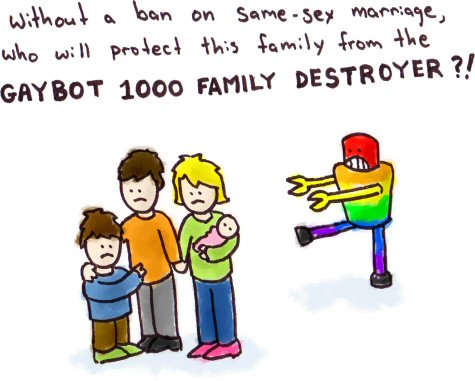
Thank god, then, for the government, who have announced the return, albeit in diluted form, of Thatcher’s Clause 28. Children in free schools or academies will in future be receiving heterosexist brainwashing instead of Sex and Relationships Education. Perhaps they can halt the cultural decline in straight people buying into holy matrimony by literally legislating for its ideological imposition? 
How obnoxiously weird that a practice designed to institutionalise the exchange of women-as-commodities should, in 2011, be being brought back as if it’s the only excellent kinship model. Over one third of marriages end in divorce, we know that only about 50% of people get married anyway - why do conservatives insist on touting the myth that marriage provides a stability that other forms of relationship don’t? Could they actually believe it, or is this a Dorries-esque way of grooming the next generation’s prejudices against the rights of those who threateningly queer the picture? 
Against all the evidence suggesting that other relationship models are also great, we are hugely invested in the ideal of marriage, in particular, in the importance of marriage to women. Popular, mildly-misogynist TV shows Don’t Tell the Bride and Four Weddings (both guilty pleasures, I admit) speak to this, camping up the ‘greatest-day-of-her-life’ aesthetic until it is too absurd to take seriously. Unless you’re Michael Gove, who presumably resolved to bring back Clause 28 during the Don’t Tell the Bride adverts. 
Given how much pro-marriage marketing we receive, perhaps it is not surprising that our common cultural conception is that it is vaguely ‘best for children’ if they grow up with married hetero-parents. The viciousness of anti-single-mother rhetoric, returning time again to narratives of blame and failure, only compounds this problem. The government spectacularly fails to consider the possible impact of such negative socialisation on children growing up in single-parent households. 
No matter. It is best for children to be brought up by married heterosexual couples , apparently, because two parents provide more stability than one. If an extra parent is so great, why wouldn’t it be better to have more than two? Why not four? Or ten? Why don’t we bring children up in communes, as envisaged by our feminist foremothers? 
I want to know why a marriage certificate makes a difference, if it is not just to get couples bogged down in financial commitments to each other so that they can’t separate. I’d like to know, moreover, how it could be better for children to grow up the company of two parents who would really rather have gone their separate ways, and why it is thought to be right that parents abnegate those - potentially eighteen - years of their lives ‘for the sake of the children’. I’d like to know why gender is presumed to make a difference to that equation, why God is genuinely believed to have given a shit about anybody’s chromosomes. 
Clause 28 is a case of cart-before-horse. There is nothing inherently better about nuclear families except the belief that they are better (coupled with tax breaks). If the children of hetero-marriages turn out to be better adjusted, whatever the hell that means, than those from other families, we need to look at the ways in which the former set of children are systematically culturally privileged and change the system accordingly. To conclude that therefore marriage is best and should be preached to kids is question-beggingly circular. It perpetuates the cycle, excluding those who can’t or won’t fit. 
I have seen at first hand that a heterosexual marriage can provide a stable upbringing in which children can grow. But I would contend that if there is anything about my orientation which would prevent me from bringing up kids in just as good a manner, it is the attitude of Gove and co, who, through Clause 28, will attempt to make sure that the society my children will grow up in will be even more full of hate than the society we have now. Thanks Gove, you utter wanker. 

Thursday, 3 November 2011

Here is my opinion, deal with it: on real life silencing and internet abuse


Edited version of this post published at Liberal Conspiracy: http://liberalconspiracy.org/2011/11/04/how-womens-voices-are-silenced-online-through-trolling/


It's funny because it's, like, true


It's difficult for women to speak in public, particularly political women. Today Helen Hasteley-Lewis blogged at the New Statesman about the torrential online abuse feminist writers get. This follows Cath Elliott's blog earlier this year on the shocking invective she personally regularly receives. At the moment, the internet is a society where being (perceived as) female and writing about feminism invariably leads to responses on the theme of: 'shut up or I will rape you/you're ugly and deserve to be raped/you're too ugly to be raped'. 

This is a form of silencing, an internalised gendered behavior which acts reflexively to suppress challenging opinions - particularly those vocalised by women. Abuse is more explicitly misogynist online, where trolls can hide behind anonymised usernames, but it isn't a phenomenon isolated to the internet. The watered-down version plays out offline all the time.

Show me a mixed gender group of any sort and I will show you a group where men speak more than women, where women are regularly interrupted, where something ignored when said by a woman will be praised when said by a man.* Debates about the merits of women-only spaces sometimes ignore the value, for women, of being in a group where they are not constantly struggling to be heard.

This is not to say that there aren't loud, opinionated, dominating women, or shy, retiring men, or that people biologically conform to a gender binary. It not to say that ALL WOMEN are one way and ALL MEN are another way. It's not to say that silencing doesn't happen along other axes of oppression, race and class being two of the rather pertinent ones. It is, however, to say that a meaningful gender analysis can be enacted on the ways that women's voices are publicly stifled. It is to say that the loud, opinionated, dominating women who want to write have to get past discriminations that loud, opinionated, dominating men don't. Online abuse is just the most blatant example of this.


How does silencing work? Partially, it works by ad feminam response. Suppose that Fictional-but-also-factual-John and I are having a discussion. I say that I think silencing is something that is usually directed against women by men in order to shut them up. John replies with, 'okay, but you don't have to be so angry about it all the time/you're cute when you're political!/did someone get out of bed on the wrong side this morning?/you don't have to make it about gender all the time/you're just saying that because you're a woman/ok...come here and kiss me/yeah but you're fat and ugly and therefore irrelevant', and so on. My opinion is sidestepped; irony abounds. Next time, it is harder to speak.


Silencing works by trivialisation of what women say, through mockery of what women say, through reducing-women-to-sexual-appearance. Subconsciously, we have internalised the idea that whatever it is, it is better if it comes from the mouth of a man than from a woman. It happens all the time. Ever seen a group of men sitting around making jokes as their female friends laugh appreciatively? I have, and I've also seen what often (but not always) happens when women try to join in. Anecdotal it may be, but at some point collections of women's experiences become overwhelming evidence. Women are being told online that they're sexually unattractive femi-nazis who deserve to be attacked, and being ignored/mocked/trivialised offline. After being silenced once, twice, a thousand times, I find it surprising that anybody has the labia to say anything at all. 

If you, of any gender, find yourself instinctively disregarding what a woman is saying, if you find yourself not listening, or wanting to interrupt, or looking at the clock, you are enacting a form of silencing. If find yourself thinking, 'what a cow/bitch/hag' when a woman is saying something in an outspoken fashion, you are taking part in the mentality of silencing. Take a step back, have a look at your own privilege, and then, please, stop doing it.


*For more on this, see Cordelia Fine's Delusions of Gender. 

Tuesday, 17 May 2011

"Business" is no excuse for prejudice

This scientific pictorial evidence confirms irrefutably that the "male brain" exists.


Today I'm mostly ranting about potential parental leave reforms at Labour Uncut. If that sounds half as overwhelmingly exciting to you as it does to me click here: http://labour-uncut.co.uk/2011/05/17/business-is-no-excuse-for-prejudice/

Sunday, 17 April 2011

Princess Kate’s reality TV wedding


Article originally published at The F Word: http://www.thefword.org.uk/features/2011/04/princess_kate_royal_wedding


Leave me out of your utterly banal "happy national celebrations", kthx bye.

“It would be extremely unwise of anyone to try and spoil a happy day of national celebration.” - Boris Johnson, feminist icon

Once upon a time, in the far away land of Berkshire, a beautiful little girl called Catherine was born to the nouveau riche Middleton family. As she grew older, she would sit by a wishing well, singing daintily to the mysteriously sentient birds that clustered there. It is said that proletarian residents of the Middletons’ village would hear strains of ‘Someday my prince will come’ floating over the wall of the house where little Kate was confined. Very shortly after Kate began singing about wanting a prince to rescue her from her debilitating solitude, he appeared. Aside from a few minor dwarf-oriented subplots, they were soon conjoined in holiest matrimony and lived happily ever after.

Wait, now I come to think about it, that might be the basic plot of Disney’s Snow White and the Seven Dwarfs, released in 1937. Nowadays, Disney heroines are very slightly less a misogynist’s wet dream, but you could be forgiven, after reading much of the media coverage of the forthcoming royal wedding, for thinking 1937 has come again (hopefully much like Snow White’s prince. And Snow White, obviously. I do hope that they both managed to come regularly during their happily married lives.)

Fictional characters’ orgasm frequencies aside, the media build up to the royal wedding has slowly but surely lubricated the royalists’ clunky marketing machine, as a result of which Kate Middleton, a rich and privileged but otherwise normal person, is re-branded as the central figure in an odd sort of fairy parable. Allusions to this archetypal story in which a peasant woman marries a prince and becomes a princess buttress the lurid media coverage. The objectionable assumption is that the archetype still has the power or relevance to transfix the nation’s imagination.

The sheer relentlessness with which attainment of princesshood is being presented as both desirable and admirable is frankly a little bit sickening. I’m under no illusions about the number of people who keep the radical feminist analysis of prince/princess mythologies that is Andrea Dworkin’s Woman Hating under their pillows (if you are one of these people please call me). But one doesn’t have to be a die-hard Dworkinite to recognise every story reporting on some irrelevant minutiae of the wedding’s organisation, and every scare about ‘anarchists’ targeting the national celebrations, as more grist to the mill of the whole gender-role-pushing, vulgar, money-spinning bandwagon.

Imagine strong, handsome, ruddy-cheeked Prince William giving up his job as a helicopter pilot to marry a prince (or a princess of the kind that is actually heir to a modicum of state power, even as figurehead)

On many accounts, Kate has given up her previous career, at least for the build up to the wedding, in preparation for the onset of princessness. It would be unfair to simply blame her for this. I can only imagine what kinds of pressures she may be under to conform to what is expected. But at the same time, I have not really seen any journalist challenge the seemingly foregone logic that marrying a prince primarily entails a full-time role as official princess.

The implication is that subsequent to the marriage, Kate’s career will be distinctly secondary, that really, her subsequent career will be ‘princess’. It is as if the title confers a difference in kind on its grateful acquirer, once merely mortal, now passively reified, admitted to the sacramental circles of the blue blooded.

As far as I can make out, the role of someone who is only a princess by virtue of marrying a prince is this: a prince’s wife, a mother to heirs, an attender of state functions, perhaps with some occasional token charity work. William will not give up his job as a helicopter pilot, nor is it suggested that he should.

Extrapolating from the favourable media reports that William asked Kate’s dad’s permission for her hand, we might be able to just about deduce that this is no modern, feminist marriage. As if Kate’s dad owns her hand, or any other part of her. A recent ‘big story’, that William will not wear a wedding ring, though Kate will, is further icing on the cake of their royally betrothed power dynamic. Unlike William, Kate will be defined merely in virtue of her marriage - something utterly antithetical to the great strides feminism is supposed to be making into the upper echelons of institutionalised sexist tradition.

Equal celebration and denigration of woman-only-as-wife are still rife in much, if not most of the national media. One needs only to contrast the considerable coverage allotted to, for example, male politicians and footballer’s female partners, with the relative obscurity of female politicians and footballers, to see this. Some writers seem to consider the right to free speech as a go-ahead for an insidious misogyny which threatens to force traditional gender roles down our throats until we stop muttering nonsense about women being human too, or whatever. The media’s wholehearted advocation of Kate Middleton as being successful, more successful than those other women who only do things like conflict resolution or working on a cure for cancer or sitting on the board of a company, is not just sexist and retrograde, but also slightly surreal.

At stake here, however, is not just the idea of woman as wife, but a specific instantiation of a riches-to-aristocracy princess mythology. Princess Kate is good, kind, beautiful, well-mannered and passive, like all fairytale princesses. What Catherine Middleton is actually like as a person is irrelevant to the story we are being sold.

The trick here is to imagine the gender roles the other way round. Imagine strong, handsome, ruddy-cheeked Prince William giving up his job as a helicopter pilot to marry a prince (or a princess of the kind that is actually heir to a modicum of state power, even as figurehead). Imagine that it is assumed he will spend much of his time henceforth raising heirs, being beautiful, going to parties and dressing well. Can you imagine this happening? I can’t. The maintenance of polarised binary gender is well and truly alive within the royal wedding’s national narrative. Kate might as well stock up on pink, glittery princess outfits from the Disney store right now, preferably from a range that does matching mother and daughter dresses (though perhaps she will hope for sons until such time as the UK sees fit to overturn male-preference primogeniture laws).

The promotion of stereotypical gender roles is blatant, but other, less conspicuous assumptions support the credulous, glowing media reports. One such assumption is that even though our society is ostensibly just about OK with homosexuality, unmarried cohabitation, non-monogamous couplings and so on - what we really should all still be aspiring to is Wills and Kate’s ideal, heterosexual marriage between young, attractive, rich white people in a church. This is marriage’s ultimate Platonic form, the reporters seem to be implying, this is what you should all aspire to. We understand that not everyone can marry their Prince Charming, but by god we should be trying to. If we can’t bring ourselves to completely renounce our wicked, sinful, fornication-outside-of-holy-matrimony ways, then we should at least pretend to be buying into the culture that supports the opposite.

Indeed, buying is the operative term. Feeding into the royal wedding’s unsubtly enforced premise of national celebration, is, of course, an unabashed assumption that we will consume as we are told. Look at how happy the nation is on this wonderful day! Buy this poorly designed tea towel! Here, have a mug as well! Not lucky enough to be invited to the special event? Oh well, cheer yourself up by pre-ordering an official commemorative coin! Even the kingdom’s peasants can take away some Wills & Kate merchandise.

Aside from being entirely revolting in itself, the furore around the royal wedding provides a current on which those with a vested interest in making money out of selling sexism can ride. One example are the odious Princess Prep classes, advertised with the tag-line ‘All little girls dream of becoming a princess’. This summer school is provided to girls (and only to girls) too young to have much developed their capacity for analytical engagement with the implications of the activities on which they are enrolled. I can’t help thinking that if the girls attending princess classes are not at the same time provided with the critical tools to make up their own minds about whether the stifling docility of the princess role is for them, it is a form of, at least… severely questionable teaching.

Even for those, both young and old, who escape such official indoctrination, the internalisation of such retrograde ideas about gender is tough to avoid in a cultural climate which is currently doing its very best to promote moral admiration of the heterosexist ‘Wills & Kate’ ideal.

This is a reality TV show wedding. It’s a little surprising that Modern-Day Princess™: Kate’s Big Day Approaches, “a fly-on-the-wall show following Kate Middleton as she prepares for the greatest day of her life”, hasn’t yet been made. The unremitting marketing, merchandising and the promotion of a sexist status quo that underpins it all is everything that might be associated with the crass value system of reality TV. The Guardian’s April Fools’ joke, that they would be running a 24-hour live blog of all the preparations from 1 to 29 April, was spot on. But I, for one, am not buying it.

Thursday, 31 March 2011

The topless Miss Salley and 825 double standards

Page 3 of yesterday's Evening Standard was a pioneering exercise in journalistic integrity. It seems that topless pictures of an art teacher named Miss Salley had been spread among students at Harrow, a public boy's school. The coverage dwelled simultaneously on Miss Salley's distress at the sharing of the pictures among pupils, and her status as a former model and 'Miss Ireland'. In other words, first, Miss Salley is a woman for whom having topless pictures is just about understandable (as models do that kind of thing). Second, because she is sexy it is understandable that the boy that found the pictures passed them around to his friends, who passed them around to their friends, and so on (because young humans with penises naturally do that kind of thing). Third, because she was upset, she was slightly redeemed. Slightly.


Harrow School boys, possibly not the bullies in question


The articles in the Evening Standard, Daily Telegraph, and (unsurprisingly) the Daily Hate could have been broken down in this manner:

1. LOOK AT THIS PICTURE OF A HOT SMOKING WOMAN!
2. Guess what happened, another teacher took some pictures of her with her tits out and all the boys saw! How shameful!
3. But it's ok, she isn't a slut, she's actually a model and they were artistic photos.
4. Also, boys at the school confirm that she is sexy. For example, one eloquently described her as a 'total babe'!
5. And don't worry, she repented. She was really upset and had to go home. Natural balance restored!
p.s. She used to go out with a rugby player!

The reasons why this story is abhorrent are almost too numerous to count. It is not just that we are supposed to look upon the schoolboy's behaviour as naughty yet permissible, it is that at the same time we are encouraged to find it all a bit titillating - reinforcing the idea (as if it needed reinforcing) that a woman's sexual shame is erotic, and that more, female sexuality is in itself shameful when not officially mediated by male permissions. In this story, the story of many women and girls, Miss Salley is the one shamed for sluttishly allowing a semi-naked representation to be taken of her, to be stolen by others. She redeems herself only by being attractive, and by being rightfully upset when others find out what she has done. Heaven help Miss Salley if she is ugly, or if she dares to not recognise her shame. This story has been told a million times and it is rarely, if ever, questioned, particularly not in the schools where it so often takes place.

I will always remember the multiple ways in which girls at my school were sexually bullied. On just one of the many occasions I could pick from, I remember hearing a conversation about the existence of a video of a girl fellating a boy in a toilet. Apparently whilst this was going on the boy's friends had taken the video over the wall of the toilet door. Just rumours about this video were enough to make me feel shocked at the temerity of the girl in question, and thoroughly embarrassed for her. What was she thinking, to give a boy head in a toilet?! How bad she must feel! What a slut! I would never do anything so base! The idea that if she should feel ashamed, the boy receiving head should also feel ashamed was never even mentioned. Nor, for that matter, was it seen to be at all embarassing or shameful to be hanging over a toilet stall door video-ing a couple having sex.

Lets take it as read that there is a massively gendered heterosexual double standard at play here, presenting the idea that it is in some way shameful to give head, but not shameful to receive it. Aside from this, it is highly strange that at no point in teenagers' lives does anybody usually sit them down and explain that this is wrong.

(Imagine you are sitting in a class full of thirteen year olds. Your teacher, a Miss Jean Brodie soundalike, stands up and says this): 'Contrary to everything else you will have probably have learned from films, television, books, parents, friends, and other aspects of our society, it is normal and ok for people to have sex. Women are not sluts for having sex, nor are they prudish for not having sex. Men are not studs for having sex, nor are they losers for not having sex. It is ok to have sex, or to not have sex. Anybody who uses the word 'slut' will henceforth be called to the Head's Office (ha) for a full explanation of their actions.'

In my feminist utopia, this lesson is read instead of morning prayers. Except, this doesn't happen, and instead sexual bullying happens time and time and time again. Obviously girls will take naked images of themselves to send to boyfriends, or friends, when the most prevalent, obvious outlet for burgeoning sexual desire is misogynist heterosexual porn, and when there is no education to suggest otherwise. Whilst young people are growing and developing their sexualities, there is little to nothing taught about gender equality, about sex being compatible with humanity, or about sex being positive and normal. Waving a condom around during one biology class is not sex education.

At what point do we begin to question where the blame really lies? Is it on the woman who experiences her sexuality in such a way as to create a naked image, or is it on a cultural attitude to the female body and to female sexuality which sexualises, commodifies and controls, whilst also blaming, shaming and denigrating? It is scandalous that the British education system is still too embarrassed, too naive, or too outright sexist to talk about sex and relationships to those who need to hear about it most. How long will it be seen as better for sexual bullying, rape, domestic violence and male-centric sex to prevail than for teachers to spend a bit of time teaching children what they don't learn elsewhere?

Here, to my mind, is how the story should have been reported:

1. Picture of public school boys.
2. Boys at Harrow public school were suspended today for attempting to bully a teacher, sexual shaming and property theft.
3. This kind of thing really shouldn't happen any more. How unfortunate. Why weren't those students educated better?
4. X, the photography teacher whose photos were stolen, is pressing charges.
5. We hope that prestigious Harrow school will recover from the shock of such behaviour, and implement better education to make sure it won't happen again.

Sunday, 5 September 2010

The Lesbian MP Scandal

This week Theresa May admitted to having once walked ('intimately' said the press) next to a nice woman who looks a bit as if she might be a lesbian. The Sun, with typical irreverance, led with 'MAY-BE A MUFFDIVER?' and the Telegraph, 'THERESA, NO SAINT'. She later released a public statement denying the circulating rumours, also confessing that her husband has suffered from kidney stones in order to dispel the claims. Of course, this follows on from Harriet Harman's separation from her husband last year in the wake of the Daily Express's secret filming of her conducting slightly flirtatious conversations with other women ('HARMAN'S FOR NO MAN'). And we all know about Baroness Amos and the famous footsie under the cabinet table with an as yet unidentified female MP ('AMOS' AMORE AMYSTERY MISTRESS?')


Theresa May, caught walking 'intimately' with women who might be lesbians

Well, not really, and perhaps I shouldn't give up the day job in expectation of a headline writing career just yet. Also I have nothing but respect for Harman and Amos. But unless I'm missing something big the national fascination surrounding 'gay' MPs is currently, boringly, for the boys only. In fact the only sexual news involving a female MP that I can remember was the one where somebody's husband watched some porn. Now, given the number of female MPs in the cabinet (like, four?) its not even slightly statistically likely that a lesbian scandal would happen to an MP prominent enough to make the news. Also, there's no doubt that the minute something like this is even whispered of, the press (and I) will have a field day. There's also no doubt that my paralyzing desire for overblown lesbian drama goes hand in hand with my dependence on The L Word. But wouldn't it be fun, if, in particular, massive homophobe Theresa was discovered to have a secret bevy of nubile beauties stashed away in her room that we all thought was dedicated solely to the dreaming up of ways to further disadvantage sexual minorities?

Wishful thinking aside, the furore surrounding gay scandals can be thoroughly disingenuous: cases of soap opera masquerading as concern for political honesty/concern for wives, and so on and so forth. In this respect it bears some similarity to the reporting of rape cases, where often the level of detail given about what exactly happened during the rape looks more like deliberate titillation (i.e. perpetuation of the 'rape isn't that bad and women mostly just make it up' myth) than news coverage. The obvious response here is that we've come to expect this from the tabloid press; the whole of its success might be put down to the ability to turn serious news into bite size drama to be juxtaposed next to someone's actual tits. But even if we expect it, it doesn't say much for the relevance or integrity, rather, of the media when the thought that two men shared a bed outside wedlock, and the subsequent fallout, is big news in every national paper.

Aside from the non-existence of lesbian political scandal, there's also a curious juvenility regarding the options given to MPS accused of sex with men. Thinking of the way the David Laws case was handled, or that of Crispin Blunt, would give anyone the impression that people, particularly MPs, are either normal and straight, or dishonest homos. Our cultural appreciation of sexuality does usually include a 'bisexual' button, but you wouldn't know it to read the press. If a male MP has sex with a man, the speculation is always over whether said MP is 'really' gay, or if he's been lying about really being straight but now is really gay, etc etc. Bisexual is never considered. That he (and I mean he, see above) might have been really straight but now be really gay and not have been lying at any point, is likewise never considered. The thought of a straight man having sex with a man once, or twice, or a hundred times, is likewise inconceivable. The contention seems to be that having sex, even once, with a member of the same sex, even if you've been married for thirty years and have five children, makes you completely one thousand percent homosexual. Its nonsensical. That's not to say that lots of people don't come out as gay after 30 years of marriage, or that sex with a member of the same sex might not change your mind, or that you might not be gay really anyway. My point is that homosexual sex isn't sufficient for homosexuality, and that this shouldn't really be news to the news.

Unfortunately its still the case that sexual orientation is understood by many people as being defined in binary fashion by the kind of genitalia you allow your genitalia to touch. Many people believe that if you solely have sex with 'people of the same sex' (whatever these 'sames' and 'opposites' mean), you are homosexual, and that if you solely have sex with 'people of the opposite sex' you are heterosexual, and that if you have sex with both you are bisexual, and that's all there is to it. This understanding is fundamentally deficient. The implicit belief in this understanding is that sexual desire aligns neatly with the gender binary (which, on this view, is real) - and so heterosexuality involves desire for the opposite gender, repulsion from the same gender, and no funny business round the edges. This, of course, says nothing about the wholly transient nature of gender identification, and more, it says nothing about the more complex nature of desire, which can so often, as we see in the news, fail to live up to expectations. This shallow understanding fails to take into account that we might desire different kinds of people in different ways, or that its possible to have sex with someone you aren't fundamentally attracted to (because you were horny, or because you were drunk, or because you were curious, or because you felt like it that day), or that there are queer and transgender and transsexual and intersex people for whom the notion of 'hetero' and 'homo' and 'bi' is something quite different, or that you might be attracted to the kind of sex acts that a person of a gender you don't usually desire wants to perform, and that this might outweigh your natural repulsion for their otherwise wholly uninviting body.

The most important problem with the above shallow understanding of sexuality is that the label 'homosexual' does, and I believe, should, carry something of identity about it in a substantial way that is ignored when same-sex sex is equivocated with sexual orientation. To suppose that homos should be just like heteros in every way except that they fuck people of the same sex supposes that hetero-norms, hetero-culture and hetero-ideology are somehow more real or natural than the homo equivalents. This is all about gender: men are a certain way, women are a certain way, and homosexuals just swap opposites for sames. But its important that homos aren't just like heteros, its important that homosexuals challenge and dispute and blur the lines of gender, and the way that different genders are supposed to look, act, and feel. Heteronormativity is no more than a bad habit that has become ingrained, to everyone's detriment. We don't see how arbitrary, how reversible, it really is.

Coming back to gay MPS, and their attendant scandals, the above is why I believe that none of this is really about dishonesty, or ability to do one's job, or that we are in any way justified in turning these things into scandals for the sake of weeding out the unworthwhile politicians. Maybe William Hague had sex with Christopher Myers, and maybe he didn't. But even if he did, there are still numerous, important reasons why he might be being entirely honest to deny that he is, or ever has been, gay.
Related Posts Plugin for WordPress, Blogger...