To celebrate National Poetry Day, here are some of my favourite feminist slam poems. They are clever, moving, amazing, and about as far from the GCSE poetry anthology as you can get, thankfully. Some are long but they are totally worth the investment. Enjoy bubbelehs, enjoy.
*trigger warning*
Staceyann Chin - My first period. Also features a haiku about George Bush. "Even Jesus had to pass through a punani Angels and messengers aside Mary had to lend passage to god Or them Christians might still be Jews Waiting for a christ that was stuck up the ass of some man Who thought he could do what little girls do Every day against our wishes"
Andrea Gibson - Letter to a playground bully from Andrea (age 8)
"I am not 'always crying',
I am just thawing outside the lines."
Sonya Renee - What women deserve
"Women do deserve better, Women deserve choice"
I think I have linked to this on the blog before, but it is just so great.
Alix Olson - Subtle sister
"So I take back the whispers, the cute, mute act and the high pitched giggles, Yeah I take them back I won't avoid your stare evade your step Nothing of that kind, I won't help you help me victimise the only space that's mine."
(Unfortunately this video is cut with other footage - but its the only reasonable version I can find on Youtube).
And finally:
Mindi Nettifee - For young women who don't consider themselves feminists (the last nerve)
Who have I missed out? Please share your favourite feminist poems below!
All of a sudden we're talking about 'a woman's right to choose' again. Threatening tactics more associated with the American anti-choice movement are steadily creeping across the pond, whilst in the States, the debate has spiralled even further downwards. On April 1st the '40 Days for Life' anti-choice campaign ends - 40 days during which abortion clinics worldwide were picketed, with abortion providers and women seeking abortions harassed, filmed, and intimidated. Recent exposes by the British Humanist Association and Feminist Action Cambridge show that anti-choice group the "Society for the Protection of Unborn Children" (SPUC) tell an incredible pack of lies during talks in schools - including the facepalm-inducing claim that abortion causes breast cancer. It's an increasingly terrifying time to be a fertile woman.
'Choice' is invaluable when framing the fight for continued reproductive rights. However much Nadine Dorries' anti-choice minions might disingenously proclaim themselves to be 'pro-woman', the fact remains that the only real pro-woman approach is one that admits of a woman's right to choose what to do with her body. The US anti-choice slogan 'women deserve better' can be seen for what it is - a blinding bit of double-think - if you can see that the implicit end of the sentence is '...than to have the right to decide whether or not to carry a preganancy to term' (of course that full slogan would be neither catchy nor persuasive). As Sonya Renee concludes in this amazing video, "women do deserve better, women deserve choice".
But feminism has more to say than, 'Great, you've chosen! Awesome! We can go home now!' Feminism as a whole is about more than enabling women to choose, even if the right to choose is a good start. The idea that feminism's end aim is just to enable women to make the choices that are right for them is almost meaningless if it isn't combined with opposition to systematic oppressions. Paid work or unpaid household labour, leaving or staying with an abusive partner, choosing underwear, opting for either Team Edward or Jacob; all of these choices are relevant for feminists (and are situated against areas of feminist thought and criticism), but not all of the options are equal.
Recently I've been hearing more and more about 'agency' - another important area for feminists which can sometimes become little more than a misused buzzword. Women's agency and women's choices aren't the same thing, but distinctions are rarely made. Choices reflect agency - but agency can be and is always constrained by more than just the choices that are available.
We need to admit both that women's agency differentiates depending on position and privilege, and that women's agency is disproportionately constrained compared to men's. The existence of some women who are more privileged than some men in no way undermines patriarchy, anymore than the existence of the wonderful Borgen undermines the awfulness that is TV (not strictly a logical analogy).
There are problems when 'agency' or 'choice' is used to block strands of feminist criticism. This debate is most often representational: the constant compulsions to be feminine, or beautiful, to wear make-up and heels, to 'perform' sexuality rather than experience it, are justified as agency-based choices which are therefore untouchable. We've got so caught up in saying 'of course you can be a feminist and wear make up and be pretty!' that we've stopped analysing the gendered institutions that create these pressures on women. Recognising that these things are gendered pressures doesn't mean you have to immediately throw your lipstick away to be a feminist, but its equally dishonest to refuse to analyze something that you happen to like.
There are some fair criticisms of feminist positions that a: suggest that women who make 'anti-feminist choices' are either devoid of agency or anti-feminist themselves, or b: speak from some sort of unquestionable position of privileged 'total agency'. It's very easy for me to point the angry-n-militant finger at the decision for breast enlargement, for example, as someone who basically lives in a library surrounded by weighty tomes and other people who mostly haven't had breast enlargement surgery. My life wouldn't improve if I modified my body in line with dominant cultural expectations. That's a massive privilege. I'm sure that cosmetic surgery might be a reasonable choice within a set of available options; this doesn't necessarily represent lack of agency, or greater false consciousness, or any of those other feminist bugbears.
When porn director Anna Arrowsmith describes pornography as a 'dream job' that 'we consent' to, though, she's really missing the point. The key to it is not to load choices with values: my choice is feminist and yours is not ("erotica is what I like, pornography is what you like"). Nor is it about decrying women who make certain choices as anti-feminist - I reckon feminists are defined by self-definition, within reason. It is past time, way past time, though, that we stopped being persuaded by attempts to paint oppressive institutions as 'feminist' through the rhetoric of 'choice' or 'you are denying my agency'.
Just because some women choose to do it, it doesn't make it ok. It doesn't make it ok for feminists to attack other (less privileged) feminists, but critique shouldn't be stifled. The undeniable agency of the woman involved is not the last feminist word on the subject. Choice is important, but it means little without criticism, and even less without change.
Oh hey! Do you like knowing you're right? Me too! What about justice? Hooray for justice! How about demonstrations of blindingly ignorant privilege coated in the faux-language of 'objectivity' or 'reason'? Wait, what..?
Privilege Denying Dude: he's always right
I didn't study gender at school. My school syllabus was based on the theories white English guys made up about the world for the past thousand years. At school, some things were up for nuanced interpretation, like English literature (a girls' subject). Sometimes, at most, we were asked to consider 'the role of women in...' But hard, manly subjects like science and maths, defined as fact, could not be disputed.
Apparently there's a major branch of theoretical thought called 'feminist epistemology', or something. Most people don't know about it, because we only learn white-guy-theories at school. One of the great things it does is to challenge the idea that what a culture thinks of as "knowledge" is objective, or neutral. Here's a quote that summarises the central point nicely:
"One cannot survey the human race from a great and learned distance, proclaiming loudly that one has found the truth for the good of all the nameless faceless abstractions that one has never bothered to take seriously." (Elshtain, 1981)
And here's another:
"Reflection on how social phenomena get defined as problems in need of explanation in the first place quickly reveals that there is no such thing as a problem without a person (or groups of them) who have this problem: a problem is always a problem for someone or other." (Harding, 1987)
In other words, feminist epistemology focuses on the roles of real people in abstract theorizing. When we're talking about knowledge, it matters who is doing the knowledge acquisition, and who the knowledge is being acquired about. The people involved - their positions as members of oppressed or privileged groups - affect what facts get churned out, and who gets to decide what counts as fact.
What falls out of feminist epistemology is the extent to which "knowledge" generally reflects the perspectives, not to mention the will to power, of the people in charge. How do societies come to believe that we are most threatened by those who are worst off: the Jews, the immigrants, the blacks, the gays, the benefits scroungers? As a direct result of the taken-for-granted "knowledges" made up by those with more power, that's how. And we believe it. We read the newspapers, we absorb the prejudices handed to us.
Dominique Strauss-Kahn, despite facing (or rather, evading) repeated allegations of rape and sexual assault, gets to speak at the Cambridge Union debating society because of these power imbalances in the process of knowing. Facts about "the law", "justice", "innocent until proven guilty" are taught to us year in and year out. These are the representative tenets of our great liberal democratic society. They are the mighty principles of the fair society, we must uphold them, free of nuance, free of interpretation, lest we become a Stalinist Soviet Union! Innocent until proven guilty! That's an objective fact! You don't get to decide the law, the law does, and the law is defined as not-wrong!
But there are other facts here that don't get heard, or taught, or learned. These are the facts about the crimes of those with more power against those with less power, and the proportion of the time that the law fails to uphold justice when the victim is a woman, or a person of colour, or someone defined as 'vulnerable'. Could a black chamber maid ever prove a rape case against the white male leader of a political body? I doubt it, whatever the evidence was.
Do I need to quote, again, the attrition rate for rape cases in the UK? It's less than 6% Do I need to mention that 1 in 7 women experience sexual or physical violence whilst students, that about 1 in 4 women are sexually assaulted as adults? Is it worth pointing out, again, how many cases there are, how few of them reach the police? What about the figure for the number of cases reported that are simply dropped due to what dominant knowledges say about false allegations?
I'm so bored of talking about these facts, but no one from the "innocent until proven guilty" camp considers this to be valid knowledge, worth using to interrogate Dominique Strauss-Kahn's free pass to propound his views. Instead, we hear "innocent until proven guilty" repeated over, and over, and over, like a cult mantra. That's the only knowledge that counts, the justice that protects the rights of the guys in charge.
What about the "innocent until proven guilty" that should have been upheld for Nafissatou Diallo and Tristane Banon? Instead we had the "guilty, just guilty" treatment meted out to Diallo, and the "you have a case, but the law is designed to stop us from pursuing it" reaction to Banon. Given that the law did nothing for them, I reckon Cambridge should give them the benefit of the doubt. I'd suggest that we should believe that they aren't just vindictive, pathological liars - but of course that's not the kind of justice that we're used to.
For what it's worth, I agree with "innocent until proven guilty". It just doesn't apply here. We don't have a fair process for finding people guilty. Dominique Strauss-Kahn isn't going to court on these charges - he got let off.
The case against Dominique Strauss-Kahn is damning: Diallo and Banon are just the women who have come forward. Their heinous treatment at the hands of the law, in the name of "justice", suggests to me that Dominique Strauss-Kahn will go on to rape and to assault with impunity. And all the while student debating societies will invite him to chat about economics. After all, it's a much more important subject, rooted in facts and objectivity. That's the stuff that really counts.
Wrongheadedly, I visited Anne Summers the other day. Hidden at the back of the store next to the 'Dominatrix' range (exclusively advertised with pictures of submissive women - I don't think they get it) was the section marked 'Porn for Women'.
A less interesting porn section could scarcely be conceived of. Whoever is designing this porn seems to think that women will descend in droves to purchase any porn which replaces the 'for men' signifiers 'slutty/anal/hungry/cock/bitch/fest' with the more delicate, pleasant, feminine word 'couples'. As if 'couples' is any draw in a film that conforms in every other respect to the male subject/female object binary.
I'm sorry for women if that's what porn 'for women' amounts to. Perhaps I shouldn't expect revolutionary female-driven narratives about sexualities and the female gaze in the Anne Summers porn section, but I would at least like to be slightly titillated. The barest hint of a sensation in the knicker department would be enough.
Still, it's only the most commercially successful sex shop 'for women', after all. In a more fringe way, women, or rather, feminists, have been conceiving of, directing and distributing feminist porn - or porn which tries to subvert the misogynist narrative - for ages. The downside is that the lack of mainstream market support results in small, independent distributors who seem to spring up and then go under (and not in the fun way, either). Last month, notably, saw the sad departure of Filament Magazine, billed wonderfully as the 'thinking woman's crumpet'.
It's a small relief that the Feminist Porn Awards are out there, attempting to give voice to the desires of those mind-numbingly bored by the restrictive fare conventionally on offer to women (let's not even get started on the soft/hardcore misogyny that passes for general/men's porn). The Feminist Porn Awards reckon that porn is feminist if it is hot and:
"1) A woman had a hand in the production, writing, direction, etc. of the work. 2) It depicts genuine female pleasure 3) It expands the boundaries of sexual representation on film and challenges stereotypes that are often found in mainstream porn."
Or, as Caitlin Moran succinctly put it, "I JUST WANT A MULTI-BILLION-DOLLAR INTERNATIONAL PORN INDUSTRY WHERE I CAN SEE A WOMAN COME."
That all sounds great, so why is it rare to find hardcore porn which fits these quite minimal criteria? There are, of course, commercial successes. There are the Anna Spans of the straight world (though her failure to look critically at mainstream porn is rather damning), and there are the Courtney Troubles and Shine Louise Houstons on the other end of the spectrum. But it isn't enough, it isn't available enough, and what there is doesn't do enough to undermine the free tube sites of the industry.
Isn't it strange that an activity which - much of the time - is something men and women do together, should be so invariably so distorted when put on camera? I don't think there is anything about the presence of a camera, or indeed a mass market, that necessarily turns sex into misogyny, but it is depressing when this is so often the case.
Lisa Saunders' interesting and well-argued anti-porn/pro-sex article on this website yesterday suggests that 'it's about as easy to get hold of 'ethical' pornography as it is to score 'ethical' cocaine.' My suspicion is that feminists will lose out if we completely write pornography off, forever, the end. The continued presence of feminist voices in other unethical industries hasn't created any feminist industries, but it has changed some things for the better.
The sustained critique of the industry and its wider cultural normalisation that anti-pornography feminisms provide are extremely persuasive, but I am reluctant to condemn all porn that exists or could exist on the basis of the industry as it stands. Women watch, and get off, on porn which doesn't cater to them, which is misogynist, racist, and unethical in every other respect. If this is the case with such rubbish porn, how much better could it be if feminist porn were to flourish?
Can feminist porn can break away from mainstream misogynist narratives? Are the criteria given by the Feminist Porn Awards enough to make porn feminist? Is there feminist porn which genuinely represents women's sexualities? Have you seen any that really stood out? What are your recommendations for feminist porn?
Good question. Tangentially relevant to this post.
My parents have been married for thirty years. I grew up in a semi-detached house in a suburb, one of three kids. The only surprise in the set-up is that we don’t have a picket fence. It was a Tory government’s wet dream of an upbringing.
Somewhere along the line, though, something went wrong. The conveyer-belt churning out endless, identical replications of this ideal kinship model hit a snag, shuddered and stopped. It turned out one of the slightly-more-than-2.4 kids was queer and at least one of the others didn’t really give a damn about marriage. Our predicted stable, nuclear futures wobbled as reality, in all its glorious diversity, failed to conform to ideology.
Thank god, then, for the government, who have announced the return, albeit in diluted form, of Thatcher’s Clause 28. Children in free schools or academies will in future be receiving heterosexist brainwashing instead of Sex and Relationships Education. Perhaps they can halt the cultural decline in straight people buying into holy matrimony by literally legislating for its ideological imposition?
How obnoxiously weird that a practice designed to institutionalise the exchange of women-as-commodities should, in 2011, be being brought back as if it’s the only excellent kinship model. Over one third of marriages end in divorce, we know that only about 50% of people get married anyway - why do conservatives insist on touting the myth that marriage provides a stability that other forms of relationship don’t? Could they actually believe it, or is this a Dorries-esque way of grooming the next generation’s prejudices against the rights of those who threateningly queer the picture?
Against all the evidence suggesting that other relationship models are also great, we are hugely invested in the ideal of marriage, in particular, in the importance of marriage to women. Popular, mildly-misogynist TV shows Don’t Tell the Brideand Four Weddings(both guilty pleasures, I admit) speak to this, camping up the ‘greatest-day-of-her-life’ aesthetic until it is too absurd to take seriously. Unless you’re Michael Gove, who presumably resolved to bring back Clause 28 during the Don’t Tell the Bride adverts.
Given how much pro-marriage marketing we receive, perhaps it is not surprising that our common cultural conception is that it is vaguely ‘best for children’ if they grow up with married hetero-parents. The viciousness of anti-single-mother rhetoric, returning time again to narratives of blame and failure, only compounds this problem. The government spectacularly fails to consider the possible impact of such negative socialisation on children growing up in single-parent households.
No matter. It is best for children to be brought up by married heterosexual couples , apparently, because two parents provide more stability than one. If an extra parent is so great, why wouldn’t it be better to have more than two? Why not four? Or ten? Why don’t we bring children up in communes, as envisaged by our feminist foremothers?
I want to know why a marriage certificate makes a difference, if it is not just to get couples bogged down in financial commitments to each other so that they can’t separate. I’d like to know, moreover, how it could be better for children to grow up the company of two parents who would really rather have gone their separate ways, and why it is thought to be right that parents abnegate those - potentially eighteen - years of their lives ‘for the sake of the children’. I’d like to know why gender is presumed to make a difference to that equation, why God is genuinely believed to have given a shit about anybody’s chromosomes.
Clause 28 is a case of cart-before-horse. There is nothing inherently better about nuclear families except the belief that they are better (coupled with tax breaks). If the children of hetero-marriages turn out to be better adjusted, whatever the hell that means, than those from other families, we need to look at the ways in which the former set of children are systematically culturally privileged and change the system accordingly. To conclude that therefore marriage is best and should be preached to kids is question-beggingly circular. It perpetuates the cycle, excluding those who can’t or won’t fit.
I have seen at first hand that a heterosexual marriage can provide a stable upbringing in which children can grow. But I would contend that if there is anything about my orientation which would prevent me from bringing up kids in just as good a manner, it is the attitude of Gove and co, who, through Clause 28, will attempt to make sure that the society my children will grow up in will be even more full of hate than the society we have now. Thanks Gove, you utter wanker.
The twitter war against @mocktheweek has finally ended. It could most closely be described as akin to a battle in which cannonballs are fired at a person who, protected by an imaginary brick wall, simply denies that the cannonballs, the wall, gravity, or any form of Newtonian law exists.
The social media face of Mock the Week, known only as "@mocktheweek", refused, in the face of all reasonability, to accept that there is anything sexist about a panel show in which women comedians are a: rarely booked and b: hate appearing when they do get booked. I can't be bothered to explain, again, why it is very, very, very, very, very sexist, so I will simply recall here that the all-female episode of Whose Line is it Anyway was one of the funnier ones. Just saying. Four comics who were women did comedy on a stage and it was funny. Anyway, if you are confused about why Mock the Week is very, very, very, very, etc, sexist, go on twitter, search 'mocktheweek', and scroll down the exchanges. I'm not linking.
Anyway, and instead, let us feast our ears on a compendium of comedians who, if they were men, would probably be Mock the Week regulars/would by now have their own road-shows and a pile of free money gifted to them by the BBC:
1. Isy Suttie:
In exhibit A (above, literally just above) we see a comedian making funny jokes to a large audience of people who are laughing. That comedian happens to be a woman, and therefore either a: will not be booked to appear on Mock the Week, or b: will not appear on Mock the Week because it is a particularly nasty atmosphere for women comedians - see Jo Brand.
2. Sarah Kendall [Edit 22/1/12: transphobia warning at around 11.30 mins]
One of my favourite comedians who probably won't ever be on Mock the Week. Unlike Russell Howard, who gets to be a regular in virtue of having a real penis, probably. I hope Sarah Kendall does go on it, but if she is her jokes will probably get edited out in favour of some look-at-me-mummy-i'm-clever-now nonsense.
3. Shazia Mirza
Bit of an obvious choice, but also, why the hell doesn't she already have her own show?
4. Josie Long
Pretty well known and stuff. Pretty funny. Probably hasn't been on Mock the Week, and I hope she doesn't go on it. I have a suspicion her style would get lost in the celebratory cockfest. She's spot on with the bit about turning 'go on then, make me laugh' guests into 'I like drinking water out of sponges' guests.
5. Here, to finish, is a trailer from the Funny Women awards of 2010. What's that about female comedians just 'not existing'?
*29/8/11: This entry has been edited to correct a mistake pointed out by 'Anonymous'*
Dear Nadine Dorries MP (and Frank Field MP, and the "up to 80%" of MPs who supposedly back you),
I am writing to commend you on your most recent attempt to obstruct women's access to abortion, specifically, the amendment on the health and social care bill stripping the British Pregnancy Advisory Service, Marie Stopes, and other abortion providers of the right to offer women abortion counselling.
The decision to force abortion providers to offer counselling with alternative, "independent" providers - defined as non-statutory bodies who do not offer abortions - shows a level of regard for women's mental health and bodily autonomy which is genuinely staggering.
I would also like to make some suggestions for some alternative, genuinely independent counselling providers. I know (though your tolerance towards the distinction between truth and pure fantasy may lead you to deny it!) that your intention is to gain enough influence over reproductive rights policy to give counselling permissions to fundamentalist Christian 'charities'. It's a shrewd decision. After all, why assault the right to abortion openly when you can sneak restrictions in around the edges! I certainly do not want to think that women considering abortions should be allowed to speak only with people who believe in reproductive rights - we don't want fickle little girls having their heads turned by abstract notions like 'choice' or 'you have a legal right to an abortion, if you want or need one'!
On the other hand, I wonder if it might not be the case that Life, etc, are not really independent enough to take proper responsibility for the lie-filled shaming service that you think should be offered to women? If those who know about abortions are to be stopped from advising or supporting women, it shouldn't be done by half measures. Instead, why not contract out abortion counselling to Dawn French in this video? (1.00 onwards)
As you can see, Dawn French's advice is just as accurate and helpful as the more conventional fundamentalist Christian options. This is a women's rights issue, after all. As someone who might, conceivably, one day be considering abortion, I want to know that my access to correct information is being chipped away at by the state's caring paternalism. Being offered counselling with Dawn French would do just the trick, don't you think? And she's so lovely about it! She could reel women in, get them to trust her, and then make them too scared to even consider abortions! (Silly, easily frightened women).
Alternatively, I recognise that in this particular video Dawn French argues for abortion (though I'm sure she could be persuaded to argue the exact opposite with very few changes needed - the sledgehammer idea could be used as a good anti-abortion scare tactic?). If you prefer, how about instead offering women abortion counselling with this bloke I met in a club yesterday? Or I hear that Justin Bieber is considering a move into the charity sector? You guys totally have all the same opinions.
Oh my god! Do you know who would be awesome as an anti-abortion counsellor? That baby elephant Dumbo from the Disney animation Dumbo ! I don't remember him speaking much but he's really cute and would definitely switch on the natural maternal instinct that every woman always has at all times. I mean, fictional characters, fictional non-information about abortion, things that actually exist, charities with abortion expertise, it's all quite similar really isn't it?
How about letting me advise women on abortion? I'll lay out the 'facts'. Like this. "Stupid little girl: you sluttily opened your legs in the first place, so now deal with the consequences. I don't care what happened to you or what your situation is. Abortion always causes cancer. Abortion makes you evil and bad. Abortion will send you to hell. Don't kill your unborn child. Look, it's probably crying 'mummy!' in the womb right now. Yeah, it's fully formed right now, after two weeks of pregnancy. Have the baby, then you're on your own. What do you think we are, some kind of nanny state?? What do you and your scavenging kid want now?! Welfare? Daycare? Jobs? Child benefits? That's not really the state's problem, soz!"
Please let me know what you think of my suggestions.
Yours, in eternal hope that you will retire from politics,
I've just been having a browse through Anders Breivik's seminal work of hateful schlock, 2083: A Declaration of European Independence. Taking into account the murder of so many people, it makes for even more depressing reading than the usual internet bile. Unsurprisingly, alongside multiple expressions of racism, fascism, Islamophobia, white supremacism, etc. etc., we have good old anti-feminism. Misogyny. Anti-womanism.
A good job has already been done over at 'Manboobz' (I don't like the name but in this case I think the posts are worth linking to), extracting some of the particularly nasty anti-women sentiments. The resident blogger also points out, most pertinently, that these sentiments aren't at all out of place in the cluster of 'Men's Rights' websites and forums that fester all over the internet.
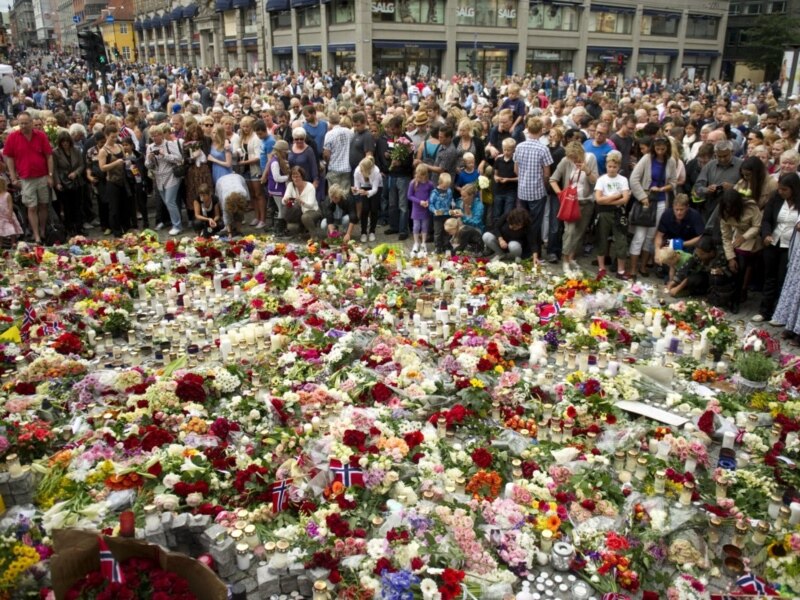
Tributes in Norway
Here, for your delectation, are a couple of beauties from the manifesto:
"Ladies should be wives and homemakers, not cops or soldiers, and men should still hold doors open for ladies. Children should not be born out of wedlock. Glorification of homosexuality should be shunned. Jurors should not accept Islam as an excuse for murder."
"Where do we see radical feminism ascendant? It is on television, where nearly every major offering has a female “power figure” and the plots and characters emphasise inferiority of the male and superiority of the female. It is in the military, where expanding opportunity for women, even in combat positions, has been accompanied by double standards and then lowered standards, as well as by a decline in enlistment of young men, while “warriors” in the services are leaving in droves. It is in government-mandated employment preferences and practices that benefit women and use “sexual harassment” charges to keep men in line. It is in colleges where women’s gender studies proliferate and “affirmative action” is applied in admissions and employment..." etc etc.
Like - I wish radical feminism was so powerful as Breivik believes? Actually, I can't be bothered to look for any more extracts. It goes on in much the same vein for 1518 pages.
Ok so the point is that this isn't just the work of one 'madman'. Breivik obviously had plenty of support from numerous others with the same ideas as him. He believed in his worldview, and he isn't the only one who does. The amount of rabid anti-feminism on the internet is shocking, and that's just the internet. I rarely meet committed anti-feminists in person (or at least, they don't tend to admit it to me) - but I know that plenty of them exist.
It is maybe the lesser of two evils that misogynists are permitted to reinforce their prejudices and disseminate their anti-woman ideology through the internet. But much, much more needs to be done before there is a widespread cultural recognition that (if you think it is helpful to speak of 'extremists' at all) anti-feminism is an extremist ideology just like racism, Islamophobia and all the rest. Its no coincidence that Breivik held all these beliefs concurrently. They're all connected.
Apologies for broken record-itis, but kids should really be taught this stuff in schools. I think that that is one of the most important steps forward for women's equality that could be made at present. It's only too obvious that where there is no education otherwise, there will be a bedrock of committed misogynists that bolster the ideas of those, like Breivik, who will go on to commit violent terror. Of course there isn't a catch-all solution to these problems, and maybe there will always be retrograde extremists who slip through the net. But it would be nice to see open sexism reduced to the same sort of level as, let's say, holocaust denial. That won't happen until we recognise the extent of the problem.
Even though she's basically the anti-christ of the world, Rebekah Brooks is a little bit cool, isn't she? Isn't she though? She's brilliant but evil. Talented but ruthless. Relentlessly successful, she conveys remorse without feeling the slightest shred of it. Possibly a domestic abuser, homophobe, racist, and/or sexist. I'll say it for her, her brand of villainy has panache. If wearing a T-shirt saying 'I heart Rebekah Brooks' wasn't the public equivalent of wrist slitting, I'd probably do it.
Massive badass
Phone hacking is only the icing on the cake of Brooks' malevolence. As Chief Exec of News Corp, she was perfectly happy to oversee the hate-n-prejudice projectile vomit that is constantly spewed out by The Sun, The NOTW, and their ilk. I heard that she had once complained about page 3, but as editor of The Sun, let's face it, she only had to stretch out her little finger to eradicate it to the folder marked 'embarrassing blights on World history'. She didn't give a damn. Instead she picked an enemy; peodophiles, and whipped up a national preoccupation; scaremongering about peodophilia.
Even when sitting in front of the Select Committee to answer for her crimes this week, she exuded an untouchable superiority that Murdoch-squared could only dream of. She combines not giving a shit with the skill of understanding just how to tap into public hysteria. It's lethal.
In fact, she's the perfect film baddie. Cast your mind up to the 130th floor of News Corp Towers. Imagine a black leather rotating chair, a gigantic semi-circle desk, and Brooks holding a massive ginger cat. You have the scene.
Except, I have a sneaking suspicion that if/when any major film company gets their dirty little hands on this story, everything I like about Rebekah Brooks will be written out. Its just too obvious that instead of a powerful evil badass, Rebekah Brooks would become a shrieking harridan straight out of the Glenn Close school of female stereotypes. Possibly played by Mick Hucknall, if the spoof videos floating around are anything to go by.
One of my favourite artworks by the Guerilla Girls sums up this trend perfectly >>
Its true. Not that Hollywood would ever do a film about one of the most important human rights movements ever, but if they did, it would look like this.
And though real life female baddies exist, in Hollywood they invariably become a: sexy skin-tight leather aficionados (not that I have anything against skin-tight leather, just, you know), b: (sexy) psycho bitches who just want to be loved by a man or c: ugly, two-dimensional objects of pity.
That's not to say that female actresses haven't, over the years, put in unspeakably strong performances as villains. Kathy Bates in Misery is incredible, for example. But she still falls under category b: evil psycho man-love-needing bitch. I can't think of any proper female film baddies who get to be powerful, where their power isn't their sexuality. Where are the female villains who get to do the awesome speech at the end about how extensively they've planned for this moment? What about the female masterminds who work out convoluted schemes for world domination? We've got real life female villains, how about celluloid ones? If Hollywood are stuck for inspiration, I suggest starting with our friend Rebekah.
It’s the same every time. A feminist politician or campaign group proposes a patently sensible idea, and the derailing begins.
The End Violence Against Women (EVAW) report is a comprehensive study on the massive prevalence of violence against women and girls, calling on Michael Gove to make a priority of educating against sexism in schools.
Great stuff. Simple common sense, even; unless you are generally in favour of violence against women. But developments like these are a starting horn for discussion derailers.
Here’s one we’ve heard before, ‘but men are victims of violence too!’ Another derailer chips in, ‘and what about female perpetrators of violence?’ We might even hear a bit of, ‘Why focus on women? Shouldn’t we just be educating children about violence generally?’
I recently saw a column by the Somalian women’s minister derailed in this way. It was outrageous, apparently, that a women’s minister should dare to write about the abominable problems specific to women in her country.
When the derailers get going, the debate takes a sudden turn to the right. Instead of discussing the part of the proposal which calls on Gove to develop schools in which girls are not subject to abuse, rape, sexual harassment, bullying or shaming, we are arguing about whether it is right to take gender-specific actions at all.
For the last time, YES, people of all genders perpetrate violence. YES, people of all genders are victims of violence. YES, there is domestic violence between same-sex partners. Now can we go back to EVAW’s proposals?
The derailers are univocally, universally missing the point. Education about violence against women cannot be simply subsumed under education about violence against people generally, and to suggest it should be deliberately ignores the scale of the problem of violence against women.
Consistent evidence demonstrates that it is disproportionately men who enact violence, and disproportionately women who are subject to it. If you want to contest this, go away and do some research.
So don’t get it twisted. The fact that other kinds of violence happen doesn’t negate the need for feminist education to combat the virulent combination of institutional misogyny, equation of masculinity with violence, and culture of sex negativity which makes sex a commodity that boys ‘get’ from girls, not something that all parties enter into consensually.
Violence against women is normalised and perpetuated when sexism goes unchallenged, but if young people are taught better across the board I’d be willing to stake my right arm, left leg and favourite hat that we will see cultural change.
No one denies that men and boys are also victims of violence. But do you know how it feels to be a woman, or a girl, where the sexual harassment, abuse and shaming starts at school and carries on into adulthood? If you don’t, talk to your girlfriend, female friends, mother, sister. They’ll put you on track.
"Peer pressure is a key contributor to early sexual activity in our country. Society is focused on sex. Teaching a child at the age of seven to apply a condom on a banana is almost saying: 'Now go and try this for yourself'. Girls are taught to have safe sex, but not how to say no to a boyfriend who insists on sexual relations."
- Nadine Dorries MP
Deceptions. Fictions. Dogmatic idiocy. Conservative MP Nadine Dorries is certainly a controversial figure. Tonight, Political Correctness Goes Mad takes an undercover* look into the sexual politics of the woman some call 'a psychotic, sexist lunatic' to find out - what the fuck is she thinking?
Hey, if we don't teach them about sex then maybe they will just never do it until they get married to nice vanilla heterosexual male-bodied people?
Last week Nadine Dorries MP managed to slime through a 'Ten Minute Rule Bill' on abstinence sex education. For girls only. I'm aware that there is not a hope in hell that this bill will become law, but still, the fact that it passed (67 to 61) is staggering.
Nadine Dorries MP's method is a little bit backhanded. She doesn't go directly for what she believes, having come to the rational conclusion that anybody with a brain cell will oppose the infliction of her prejudices onto wider society.
In this vein, the above quotation is strange. If not for the absurd and evidentially incorrect idea that teaching children how to put condoms on bananas will lead to an uncontrollable spate of young banana-rubbering hobbyists, one might even agree with it. Peer pressure does contribute to 'early', whatever this may mean, sexual activity. Girls are not taught how to say no to a boyfriend that insists.
Sure, we are taught that saying no is an option, but we aren't taught how to do it. We aren't taught how to say no when you're attracted to the other person and you want to fuck them but you don't have any means of getting protection. We aren't taught how to say no when you sort of want to, but you sort of don't want to, and you sort of think maybe another time might be better but you don't want to reject the other person completely and you don't want them to get angry. Dorries is also right insofar as we aren't taught to say no when the other person wants to and you totally don't. That's still a problem, and a serious one.
But we also aren't taught how to say yes, and this should be equally important. There are no lessons on saying yes when you want to have sex so badly and blood is pumping around your body and your cunt is a more pH neutral version of the Thames but you don't know how to convey to your (willing) partner that you also want to. Its difficult to know how to say yes when you're scared of being rejected, or called a slut, or that they might tell their friends at school.
Perhaps its different now, but in my day sex education focused solely on the conveniently erect penis going in the mysteriously self-lubricating vagina. ('When the penis goes in the vagina, the vagina becomes aroused and moistens') Really, sex education in 2001? What if your vagina prefers vagina, or what if you don't like penetration that much, or what if you need a bit more than that to get you off? Where in god's name is the discussion of the clitoris? What if you like to be tied down and spanked with a portrait of George Elliot whilst free jazz plays in the background? (this has nothing to do with my sex life, by the way)
Ok, so Nadine Dorries MP's conclusion from all these difficulties with navigating sexual exploration, is not that children need to be more comprehensively educated, but that we should attempt to stifle their burgeoning sexualities by TEACHING ABSTINENCE.
Sorry Nadine Dorries MP, but being taught to say no when you mean no, and yes when you mean yes, and how to do it differently when you need it to be done differently, has nothing to do with abstinence. Being taught abstinence suggests that sex is dirty, or wrong, or evil. This kind of 'education' has a counterproductive effect, heightening occurrences of rape, unwanted pregnancy, STD transmission, and generally unsatisfying sex because you haven't been taught how to do it at all, let alone how to do it well. This kind of ideology can't even really be described as education. It is the opposite to everything education should stand for: regressive, dogmatic, and ultimately, very very sexist.
That Dorries tries to wrap up her odious beliefs in slightly palatable seeming policy is all the more reason to oppose her. It is staggering that there are 67 people in Parliament who thought her ideas were reasonable rather than self-evidently GROTESQUE. We need to be constantly aware that these people still exist.
*Please note, by 'undercover' I mean that I'm writing this in bed. Now, back to practicing condom application on this bunch of phallic fruits.
The Daily Mail Mantra for Successful Article Writing
What an amazing day for news stories to boil the blood! The first occurrence was the deafening arrival of Melanie 'probably a lesbian' Phillips into my field of reference. In that bastion of enlightenment known as the Daily Mail, she wrote an opinion piece containing some unbelievable lunacy about 'The Gay Agenda' and its supposedly relentless drive to indoctrinate children. Here are some real, live, actual sentences from the article:
'...mad as this may seem, schoolchildren are to be bombarded with homosexual references in maths, geography and science lessons as part of a Government-backed drive to promote the gay agenda.'
and
'Alas, this gay curriculum is no laughing matter. Absurd as it sounds, this is but the latest attempt to brainwash children with propaganda under the camouflage of education. It is an abuse of childhood.'
and
'It seems that just about everything in Britain is now run according to the gay agenda.'
You read that correctly. Melanie Phillips actually, in nationally published print, described the possibility that children might one day be taught that same-sex oriented penguins exist, as 'an abuse of childhood'. Not just 'something I disagree with', but 'an abuse of childhood '. I think out of any subset of people that includes Melanie Phillips, somebody needs to acquire some perspective.
Anyway, if she's right about this unjustifiable incursion of tolerance and understanding into our national education, I for one would like to find the gay agenda and her sinful sexual partner (the 'belief in equal rights for all agenda'?) wherever they're currently living, and give them a good talking to. There'll be no dirty homos in my B&Bs or in my schools, that's for sure. Disgusting. We all know that homosexuality doesn't exist in Iran, so maybe we should take a leaf out of their book? On the other hand it was difficult to get too worked up about this (I thought, some time after I'd calmed down) given that it is just so, so, blatantly hateful that nobody can feasibly be taking it seriously.
But then a Tory MP from the esteemed Fathers 4 Justice school of gender analysis decided that teh menz are terribly oppressed, and called for 'men's equality'. His comments were made in light of recent news concerning the disproportionate and unfair number of successful women in politics, business, sport, all other companies, and the world. He also said something about how women now rule the world, officially, because now, all of a sudden, it is primarily men who suffer from domestic and sexual violence at the hands of women, and also women own like a thousand times more land and property than men, and women's affairs dominate the world political agenda, and 70% of the people who live in poverty in the world are men, and men are continually denigrated in all world cultures, and in many countries men aren't allowed out by themselves and have to cover up their faces in case they inflame the violent passions of libidinous women, and most words that represent negative qualities are masculine ones, and we tend to refer to all people as 'she', conveniently ignoring the relevance or importance of male existence. Then he went on to describe the way in which the main burden of childcare and domestic household responsibility still falls on men, and about how men still don't have much medical or legal control over their bodies or reproductive capacities. And apparently there are now massive problems with the manipulation of the male image in the media, leading to disproportionate numbers of young men developing anxieties about their bodies, leading to eating disorders and so on. And also this is only exacerbated by a multi-billion pound porn industry which is mostly comprised of male-submissive fetish material rewrapped as normal heteronormative sexuality. Oh wait, hold on...
Anyway, the Tory MP has been all over the papers saying something about men being oppressed and feminists being the worst kind of bigots, which sounds extremely reasonable and is definitely backed up by true facts.
Why do people in positions of relative privilege feel so threatened by the smallest advances in civil rights movements? It is surely hardly anything to Melanie Phillips if kids get taught about the existence of homosexual and transgender people in schools, and it is hard to see how it can be particularly threatening to well-moneyed Tories that the women's movement has made some legislative progress over the last thousand years.
It also wouldn't take much for anti-feminists of the masculinist ilk to actually read a bit of feminist theory and find out that all the issues they point to, fairly, as gender constraints on men, are all the same issues that feminists have previously pointed out as gender constraints on men. Nobody wants additional paternity leave and stretching of understandings of the male gender role more than feminists do, and given that this information is well-known and easily available, I can't help but think that the focus on straw-feminism masks nothing more than internalised contempt for feminist challenges to female gender roles.
This brings me, finally, to what was originally intended as the focus of this increasingly lengthy diatribe. The final story of the day concerned two men's football commentators, Andy Grey and Richard Keys, making abhorrently sexist comments about lineswoman Sian Massey. The video below doesn't quite detail the extent of the comments but it gives a representative indication of the flavour of the conversation.
The thing is that all of this isn't particularly unbelievable. Where I'm surprised that homophobes like Melanie Phillips still get a voice today, even in the Daily Mail, its not at all surprising that those involved so deeply in men's football are sexist. Well, duh? Professional men's sports in the UK, particularly football, are among the most overtly sexist fields that there are. Sexism is accepted as part of the culture of men's football. Whilst there are loads of men in women's football, with some very honourable exceptions aside, there are next to no women working successfully in men's football. Nobody currently bats an eyelid that the women's game hardly ever gets on TV and invariably isn't in the papers, even when the women's side are world champions.
This was really brought home to me the other day when speaking to a woman from Sweden, who told me that moving to England had been a massive shock for her, because she'd turned on the TV to catch up on the football, and found that women's games weren't covered. Think about it. There are approximately twenty million Sky TV channels exclusively dedicated to sports, but I'd estimate (with no particular backing evidence, are there any studies on this?) that time given to women's sports is less than 15%, with much of that given over to women's tennis and athletics. In almost every newspaper in England there is a section at the back misleadingly entitled 'Sport', which openly and unapologetically reports on only half the sports that take place. I see this as grossly obvious sexism, yet it seems to go unnoticed, or at least, unmentioned, by most people for most of the time.
This is important because men's football is one of the big, stereotypical drivers of male homosociality, a.k.a the way in which some men cluster around worship of masculinity in a bonding way that excludes female participation except at a secondary level. I fundamentally object to the idea that I should go to a pub and peruse a male sporting event; that I should use masculinity-appreciation as a tactic for bonding with my friends when I know damn well that the same thing would never happen for a women's game. More, in the appreciation of traits we associate with maleness, strength, skill, stamina, and so on, there is an implicit celebration of man as not-woman. It is this kind of attitude that keeps women's sports relegated to the sidelines (what?! women who can do these things too?!) and that preserves involvement in and appreciation of high-end men's football as a men's-mostly pursuit.
Some commenters from the political-correctness-gone-mad brigade (also known as the 'don't challenge our prejudices' club) apparently thought Andy Grey and Richard Keys' comments were, and I hesitate to use to word, 'banter'. I personally think that they should both be summarily executed, that men's football should be banned from television or newspapers, and that it should be illegal to show men's sports in public places. As ever, though, this is just my all-powerful gay feminazi bigot's agenda, the truth probably lies somewhere in the middle, so let's just sack the both of them, have more coverage of the women's game, and have done with it.
This is what an anti-rape/rape awareness campaign should look like. This is SO much better than those horrific, triggering, titillating, victim-blaming ads that Tfl have only very recently taken down. Here some of the regressive, sexist ideas that I got from the last Tfl campaign:
a. It is a woman's responsibility not to get raped.
b. If you have been in an illegal minicab, worn revealing clothing, had a drink, flirted, spoken to someone, walked home alone, kissed someone, walked home in the dark, walked home with female friends, been outside with female friends, danced in a club, been inside with your windows open, failed to fight back enough, passed out in your friend or boyfriend's bed, fallen asleep generally, not shouted 'no!' repeatedly, loudly and clearly enough when someone is trying to rape you, AND SO ON AND SO ON AND SO ON you are in some way responsible or to blame for the fact that someone has raped you.
c. There will always be rapists because rape is a natural male urge, therefore anti-rape campaigns should just be damage limitation.
The point is, no matter how many precautions you take, you may still get raped. The point is, men face no such restrictions on their movements. As long as there are still rapists, there will still be rape survivors. As long as advertising solely urges women to take precautions, there will still be a world of ignorance out there, in women and men, about what is and isn't rape. So, you know, maybe the London authorities could allocate just one of their campaigns to raising awareness about what rape actually is? So that when a woman, having taken all other precautions on all the other days of her life HEINOUSLY SLIPS UP AND HAS ONE TOO MANY DRINKS, the person who may otherwise have committed rape, thinks about it and does not do so?
Here are three counterarguments to what I've just said. First, there will always be rapists so it is unrealistic to expect advertising to stop rape. Second, 'women-take-precautions!' adverts do something concrete to help so it is counterproductive to argue against them. Third, we don't campaign against other crimes by asking people not to commit them, i.e. a campaign saying 'don't murder' would be ludicrous.
I find the third the most immediately convincing of these counterarguments, and certainly its the one I've seen most used on internet forums and other places where such issues get discussed by calm, rational people. But the problem with it, as an argument goes, is that it fails to take into account just how much confusion there is surrounding rape. Like, killing is killing. If you kill someone you are a murderer, unless you are in some way legally less responsible, in which case it is manslaughter, which is also a very serious crime. Nobody thinks it is not real killing if you get killed by your partner. The only way you might be in some sense responsible for your own murder is if you have a history of violence against the person that kills you. If you walk home by yourself it's not your fault if you get killed. There might be other issues to discuss, but it is still killing. Rape is a different story. So many people, myself included, are unsure, in some cases, about whether what has happened is rape or isn't rape.
The recent 'Wake Up To Rape' (I think it's an unfortunate title, but hey) survey run by The Havens, based on a random sample of 1061 people in London, found that:
-Close to one in five respondents agree with the statement, "most claims of rape are probably not true" (18%)
-Close to one in five respondents do not know whether in a committed relationship it is rape when a man makes their partner have sex when they don't want to (18%)
-One in ten do not believe it is rape when a man makes their partner have sex when they don't want to (10%)
-20% of people have been made to have sex when they didn't want to.
Even taking into account a possible bias either way from the kinds of people who respond to rape surveys, I think some of these statistics might be related? Here's a feasible argument: if quite a large percentage of people are unsure what is and isn't rape, some people are committing rape through ignorance rather than willful criminality. Isn't it possible that some people may be stopped from raping if they know that what they are doing is a crime?
Let's talk about the second of the counterarguments, that if this kind of advertising stops even one person from being raped, it's doing its job and therefore, to campaign for removal is ridiculous. To some extent, this argument has a point. Of course it is better to have advertising that helps even slightly than nothing at all. But neither is it right to be entirely uncritical about what there is. When what there is could be improved, why not improve it? I do not frankly believe that there could be many women who have not been told repeatedly all their lives not to take endless, onerous security measures. I can't walk home by myself without hearing my mother's 'I don't like you out alone at night, it's not safe. Don't wear that skirt. Be careful not to drink too much.' voice resounding around my head. I don't think there is really a lack of awareness amongst women about staying safe, but there definitely is a lack of awareness among people about what consent is, what consent isn't, and about in what situations sex is rape. I will continue to contend for as long as it takes to anyone who will listen that it is in no way necessary or good to have anti-rape advertising that is so very distressing to both rape survivors and non-rape survivors (I MEAN, WHY ARE WE LOOKING AT THE WOMAN FROM THE PERSPECTIVE OF THE RAPIST IF THE AD IS TARGETING POTENTIAL ATTACKEES?! Talk about male gaze!). The same point can be made in a million different, almost invariably better ways. The Tfl campaign was made with little to no collaboration with women's groups who, you know, work on this stuff for a living. The new one, which has just gone up, is a little better if just less graphically traumatising, but still doesn't really hit the mark in the way that 'Don't be that guy' does. If it is felt that a safety based campaign is necessary, why not couple it with one like the Canadian one featured above? Its not like there could be too many.
Last, the first counterargument, that it's unrealistic to expect advertising to stop rape. I've pretty much answered this already anyway. It's hugely patronising to men to suggest that rape on such a large scale is inevitable. We can, at the very least, reduce occurrence of rape to roughly the same occurrence as most other crimes.
Back to the Canadian campaign. Its not just that it places the onus squarely where it belongs, on those who may not know what constitutes rape or who may otherwise feel tempted to rape. It also makes clear that those men who become rapists are not, generally, psychopaths or lurking-behind-bushes-weirdos, rather, rapists are everyday men who for whatever reason (pick some: they don't think its rape, lack of awareness/understanding/empathy, patriarchy, dehumanisation of women, misogyny, participation in culture that blames women for rape, internalisation of raunch culture ideals about female sexuality, fallout from society that demonizes women for saying yes or no or nothing, etc etc etc) choose to exercise unwanted power over a woman, man or queer against their will.
I'll leave you with a really great comment I saw on a facebook group called 'Please please stop victim blaming on the London Underground', from a person called Kay Ri, who I hope won't mind me reproducing it here:
"Incidentally, when a thief is found with his hands full of stolen Christmas gifts, legal professionals tend not to conjecture that the theft was a willing donation.
"But Mr. Smith, you give to charity all the time-are you sure you didn't just make a big donation and then regret it the next morning?"
"You say that they were Christmas presents Mr. Smith; is it not true that Christmas is a time of giving? And yet you *claim* they were stolen...""