Thursday, 12 January 2012

A well regulated press would also be a freer press, if it could do anything to end media sexism

Not another picture of Pippa Middleton's ass

The Leveson inquiry drags on, akin to the 1000 pages in the middle of The Lord of The Rings where the hobbits do nothing but walk across a cliff. We're still only on the first half - the bit of the inquiry in which press culture, ethics and practices are vigorously talked about. In fellowship terms, we're barely out of the shire.


Lord Justice Leveson is now indicating that he is unlikely to consider any government regulation. That may not be so disappointing, given the government's seeming view on regulation, otherwise expressed as 'we hate regulation'. But this does leave us to speculate on exactly what actions Leveson may be intending. In a manner quite dissimilar to that of Tolkien's oeuvre, the inquiry does not seem to be leading to any massive inexorable conclusions. 

At the end of last year coalition of mainstream feminist groups (the End Violence Against Women coalition (EVAW), Eaves, OBJECT and Equality Now) submitted to the Leveson inquiry that it should address press sexism as part of a full investigation into the relationship between media and society.* How unbelievably heinous; it takes a country-wide media culture overhaul to enable official challenge to media myths of the alien species, 'women', who do nothing but lie about rape, wear clothes, or not wear clothes.


In this video, a Sky News commentator speculates - ever so insightfully - that the inquiry's outcome may be a 'tougher, beefed up, testosterone fuelled regulator.' Sexist language aside (and the identification 'good=masculine' could be one of the first things to go, if you ask me) a proper independent press complaints commission would seem to be one highly logical outcome of the inquiry. We already have one, after all, giving it teeth would be relatively easy. 

The problem is that enabling it to take action against sexism would take greater ovaries than Leveson could ever countenance. The culture is too longstanding, and it runs too deep in the national psyche. The suggestion of any anti-sexist regulation stronger than 'um, guys, can you please play nicely?' is invariably met with the outraged cry: 'FEMINIST CENSORSHIP!!!!' or 'A FREE PRESS IS THE SOLE HALLMARK OF A DEMOCRATIC SOCIETY!!!' or, as with Clare Short's campaign to end Page 3, you are clearly just 'fat and ugly' and 'jealous of beautiful young women'. 


Here is what will (probably) happen instead. Between now and the announcement of a new PCC, the bit of the inquiry that was about countering media misogyny will get lost. Or looked over. Or watered down so much that it will become irrelevant. Some concession may be made to not displaying 'inappropriate' materials pre-watershed, 'where children can see'. But the banal onslaught of everything that is idiotic in our culture, the four hundred pictures of Pippa Middleton's bum, the appraisal of women politicians on the basis of their clothing choice - all this will continue.

Those who get on the high horse about the inalienable right to free expression forget that in practice this has meant the unabated reproduction of unsubstantiated ideologies about less powerful groups who, non-coincidentally, have less press control. The people who read rape reports focusing mainly on 'false' accusations, skirts, and alcohol consumption, are the same people who comprise juries who sit in on rape cases from which rapists repeatedly walk free. That's the very definition of a vicious circle.

To mandate that women should be represented as people who partake in the public sphere in roles which are not primarily aesthetic is simply to mandate representations closer to the truth. An end to the barrage of boobs and bimbos would make life a lot freer for the women who would like to be assessed on the basis of their actions rather than for the shape of their behinds. I hope Lord Leveson is brave enough to say so.


*Disclaimer: I don't agree with everything that was put forward by all of these organisations, but implementation of anything vaguely anti-misogynist would be better than what we have now. 

Friday, 16 December 2011

All I want for Xmas is a stocking full of really arousing feminist porn


Originally published at The F Word: http://www.thefword.org.uk/blog/2011/12/all_i_want_for_


This isn't quite doing it for me


Wrongheadedly, I visited Anne Summers the other day. Hidden at the back of the store next to the 'Dominatrix' range (exclusively advertised with pictures of submissive women - I don't think they get it) was the section marked 'Porn for Women'.

A less interesting porn section could scarcely be conceived of. Whoever is designing this porn seems to think that women will descend in droves to purchase any porn which replaces the 'for men' signifiers 'slutty/anal/hungry/cock/bitch/fest' with the more delicate, pleasant, feminine word 'couples'. As if 'couples' is any draw in a film that conforms in every other respect to the male subject/female object binary.
I'm sorry for women if that's what porn 'for women' amounts to. Perhaps I shouldn't expect revolutionary female-driven narratives about sexualities and the female gaze in the Anne Summers porn section, but I would at least like to be slightly titillated. The barest hint of a sensation in the knicker department would be enough.
Still, it's only the most commercially successful sex shop 'for women', after all. In a more fringe way, women, or rather, feminists, have been conceiving of, directing and distributing feminist porn - or porn which tries to subvert the misogynist narrative - for ages. The downside is that the lack of mainstream market support results in small, independent distributors who seem to spring up and then go under (and not in the fun way, either). Last month, notably, saw the sad departure of Filament Magazine, billed wonderfully as the 'thinking woman's crumpet'.
It's a small relief that the Feminist Porn Awards are out there, attempting to give voice to the desires of those mind-numbingly bored by the restrictive fare conventionally on offer to women (let's not even get started on the soft/hardcore misogyny that passes for general/men's porn). The Feminist Porn Awards reckon that porn is feminist if it is hot and:
"1) A woman had a hand in the production, writing, direction, etc. of the work.
2) It depicts genuine female pleasure
3) It expands the boundaries of sexual representation on film and challenges stereotypes that are often found in mainstream porn."
Or, as Caitlin Moran succinctly put it, "I JUST WANT A MULTI-BILLION-DOLLAR INTERNATIONAL PORN INDUSTRY WHERE I CAN SEE A WOMAN COME."
That all sounds great, so why is it rare to find hardcore porn which fits these quite minimal criteria? There are, of course, commercial successes. There are the Anna Spans of the straight world (though her failure to look critically at mainstream porn is rather damning), and there are the Courtney Troubles and Shine Louise Houstons on the other end of the spectrum. But it isn't enough, it isn't available enough, and what there is doesn't do enough to undermine the free tube sites of the industry.
Isn't it strange that an activity which - much of the time - is something men and women do together, should be so invariably so distorted when put on camera? I don't think there is anything about the presence of a camera, or indeed a mass market, that necessarily turns sex into misogyny, but it is depressing when this is so often the case.
Lisa Saunders' interesting and well-argued anti-porn/pro-sex article on this website yesterday suggests that 'it's about as easy to get hold of 'ethical' pornography as it is to score 'ethical' cocaine.' My suspicion is that feminists will lose out if we completely write pornography off, forever, the end. The continued presence of feminist voices in other unethical industries hasn't created any feminist industries, but it has changed some things for the better.
The sustained critique of the industry and its wider cultural normalisation that anti-pornography feminisms provide are extremely persuasive, but I am reluctant to condemn all porn that exists or could exist on the basis of the industry as it stands. Women watch, and get off, on porn which doesn't cater to them, which is misogynist, racist, and unethical in every other respect. If this is the case with such rubbish porn, how much better could it be if feminist porn were to flourish?
Can feminist porn can break away from mainstream misogynist narratives? Are the criteria given by the Feminist Porn Awards enough to make porn feminist? Is there feminist porn which genuinely represents women's sexualities? Have you seen any that really stood out? What are your recommendations for feminist porn?

Tuesday, 13 December 2011

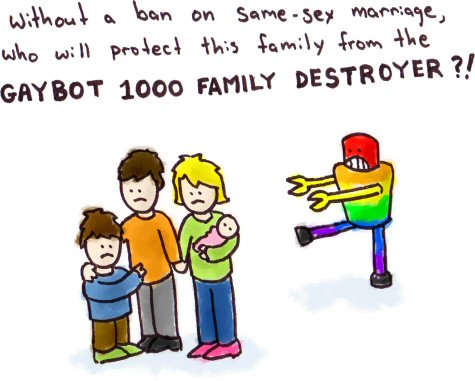
Familes are not factories

I'm guest blogging at The F Word this December! This is the first post, published last week: http://www.thefword.org.uk/blog/2011/12/post_6


Good question. Tangentially relevant to this post.


My parents have been married for thirty years. I grew up in a semi-detached house in a suburb, one of three kids. The only surprise in the set-up is that we don’t have a picket fence. It was a Tory government’s wet dream of an upbringing. 
Somewhere along the line, though, something went wrong. The conveyer-belt churning out endless, identical replications of this ideal kinship model hit a snag, shuddered and stopped. It turned out one of the slightly-more-than-2.4 kids was queer and at least one of the others didn’t really give a damn about marriage. Our predicted stable, nuclear futures wobbled as reality, in all its glorious diversity, failed to conform to ideology.  
Thank god, then, for the government, who have announced the return, albeit in diluted form, of Thatcher’s Clause 28. Children in free schools or academies will in future be receiving heterosexist brainwashing instead of Sex and Relationships Education. Perhaps they can halt the cultural decline in straight people buying into holy matrimony by literally legislating for its ideological imposition? 
How obnoxiously weird that a practice designed to institutionalise the exchange of women-as-commodities should, in 2011, be being brought back as if it’s the only excellent kinship model. Over one third of marriages end in divorce, we know that only about 50% of people get married anyway - why do conservatives insist on touting the myth that marriage provides a stability that other forms of relationship don’t? Could they actually believe it, or is this a Dorries-esque way of grooming the next generation’s prejudices against the rights of those who threateningly queer the picture? 
Against all the evidence suggesting that other relationship models are also great, we are hugely invested in the ideal of marriage, in particular, in the importance of marriage to women. Popular, mildly-misogynist TV shows Don’t Tell the Bride and Four Weddings (both guilty pleasures, I admit) speak to this, camping up the ‘greatest-day-of-her-life’ aesthetic until it is too absurd to take seriously. Unless you’re Michael Gove, who presumably resolved to bring back Clause 28 during the Don’t Tell the Bride adverts. 
Given how much pro-marriage marketing we receive, perhaps it is not surprising that our common cultural conception is that it is vaguely ‘best for children’ if they grow up with married hetero-parents. The viciousness of anti-single-mother rhetoric, returning time again to narratives of blame and failure, only compounds this problem. The government spectacularly fails to consider the possible impact of such negative socialisation on children growing up in single-parent households. 
No matter. It is best for children to be brought up by married heterosexual couples , apparently, because two parents provide more stability than one. If an extra parent is so great, why wouldn’t it be better to have more than two? Why not four? Or ten? Why don’t we bring children up in communes, as envisaged by our feminist foremothers? 
I want to know why a marriage certificate makes a difference, if it is not just to get couples bogged down in financial commitments to each other so that they can’t separate. I’d like to know, moreover, how it could be better for children to grow up the company of two parents who would really rather have gone their separate ways, and why it is thought to be right that parents abnegate those - potentially eighteen - years of their lives ‘for the sake of the children’. I’d like to know why gender is presumed to make a difference to that equation, why God is genuinely believed to have given a shit about anybody’s chromosomes. 
Clause 28 is a case of cart-before-horse. There is nothing inherently better about nuclear families except the belief that they are better (coupled with tax breaks). If the children of hetero-marriages turn out to be better adjusted, whatever the hell that means, than those from other families, we need to look at the ways in which the former set of children are systematically culturally privileged and change the system accordingly. To conclude that therefore marriage is best and should be preached to kids is question-beggingly circular. It perpetuates the cycle, excluding those who can’t or won’t fit. 
I have seen at first hand that a heterosexual marriage can provide a stable upbringing in which children can grow. But I would contend that if there is anything about my orientation which would prevent me from bringing up kids in just as good a manner, it is the attitude of Gove and co, who, through Clause 28, will attempt to make sure that the society my children will grow up in will be even more full of hate than the society we have now. Thanks Gove, you utter wanker. 

Friday, 2 December 2011

Related Posts Plugin for WordPress, Blogger...